Sarvangasana Yoga
Introduction — What Is Sarvangasana Yoga?
The Sarvangasana Yoga, or the Shoulder Stand, is considered to be one of the best yoga inversion techniques in the ancient and modern yoga tradition that is useful in medicine. The yoga traditions highly extol it as it is the Queen of Asanas that has enormous physical, physiological, and mental advantages. This entire body posture is done in a sensitive manner in order to resist the pull effect of gravity, but rather, it pumps the blood to the upper body and the brain, thereby refreshing and renewing the system.
What Is Sarvangasana? Meaning & Historical Yoga Context
The term Sarvangasana originates from Sanskrit:
| Sanskrit | Meaning |
| Sarva | Whole / Entire |
| Anga | Body / Limbs |
| Asana | Posture / Pose |
Thus, the literal interpretation is a whole body posture. In this pose, the yoga novice will lift the body up with arms (shoulders) and straight to the sky with the legs, in an inversion.
Contrary to the majority of the yoga poses, Sarvangasana is a practice of the opposite end; the heart lies higher than the head, the work of the circulatory, lymphatic and endocrine glands is provoked, and so is the nervous system. It is also one of the peculiarities of this property predetermining its popularity in the sphere of therapeutic and restorative yoga.
To a Hatha Yoga practitioner, Sarvangasana is frequently preceded by warming poses:
- Halasana (Plow Pose) – stretches spine and shoulders
- Viparita Karani (Legs Up the Wall Pose) – gentle inversion for relaxation
- Bhujangasana (Cobra Pose) – opens chest and strengthens the spine
After Sarvangasana, counterposes are recommended to realign the body and avoid tension:
- Matsyasana (Fish Pose) – opens the throat and chest, balancing the inversion
- Setu Bandhasana (Bridge Pose) – strengthens spine and glutes, neutralizing the cervical region
Key Benefits of Sarvangasana Yoga
Sarvangasana has a lot of benefits in terms of not only physical health but mental health as well. This pose is something to practice on a regular basis in order to become very vital..
Enhances Blood Circulation
The natural inversion like Sarvangasana helps in the redirection of the lower limb venous blood towards the heart and the brain. This increased blood circulation maximizes the delivery of oxygen and nutrients throughout the body which leads to:
- Reduced edema and leg swelling
- Improved vascular and vein health
- Heightened alertness and sustained energy
Stimulates Thyroid & Endocrine Function
Cervical pressure of Sarvangasana is directly acting on thyroid and parathyroid glands. This hormonal balance promotes the metabolism, energy levels, and growth.
People who have mild hypothyroidism or slow metabolic rate can incorporate Sarvangasana in their daily lives as long as they are given the clearance by a healthcare practitioner.
Strengthens Shoulders, Upper Back & Core
Lifting the body against gravity activates:
- Shoulder muscles, including deltoids and rotator cuffs
- Upper back muscles, particularly trapezius and rhomboids
- Core muscles — abs and obliques — are essential for balance and stability
Regular practice promotes upright posture, spinal alignment, and muscular resilience.
Supports Digestion & Detoxification
Venous returns. Inversion facilitates abdominal organ (liver, stomach, pancreas and intestines) venous return, which assists:
- Efficient digestion
- Natural detoxification
- Improved gut motility
A lot of practitioners claim that they feel lighter, more energized and cleansed after the usual practice.
Calms the Nervous System
Sarvangasana activates the parasympathetic nervous system or the so-called rest and digest mode. Benefits include:
- Reduction in stress and anxiety
- Decreased restlessness
- Preparation for meditation or restorative practices
Boosts Cognitive Function & Mental Clarity
Blood flow to the brain increases during inversions, enhancing:
- Memory retention
- Focus and concentration
- Creative thinking
This allows Sarvangasana to be the choice of students, professionals and those in need of being mentally sharp.
Step-by-Step Instructions — How to Do Sarvangasana
Time: Beginners should start with 15–30 seconds, gradually increasing to 2–3 minutes.
Props: Yoga mat, folded blankets, optional blocks.
Step-by-Step Guide
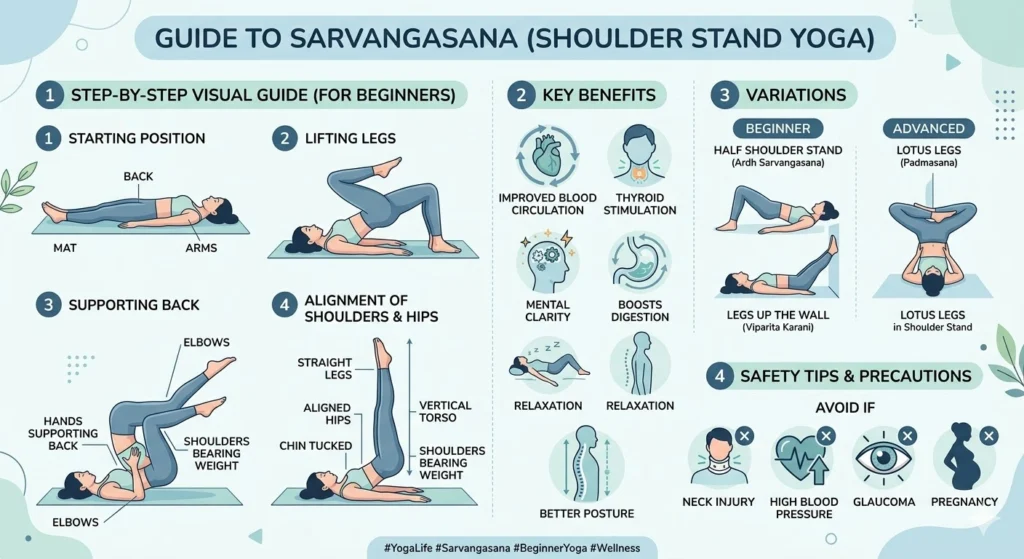
- Lie supine on a yoga mat with a relaxed spine.
- Place folded blankets beneath the shoulders, ensuring the neck remains free.
- Inhale deeply and lift legs toward the ceiling, forming a 90° angle.
- Support the lower back with both hands, lifting hips upward.
- Align hips above shoulders, keeping legs straight and toes pointing skyward.
- Maintain steady, even breathing throughout.
- To release, slowly lower the body vertebra by vertebra until lying flat.
Proper Form — Alignment Checklist
Weight Distribution:
- Shoulder muscles bear the load, not the cervical spine.
Legs & Hips:
- Legs remain fully extended.
- Hips should be stacked over shoulders.
Hand Placement:
- Hands support lower back, elbows grounded.
Breathing:
- Inhale and exhale smoothly, avoiding breath retention.
Muscles Engaged in Sarvangasana
| Area | Muscles |
| Shoulders | Deltoids, Rotator Cuff |
| Upper Back | Trapezius, Rhomboids |
| Core | Abs, Obliques |
| Legs | Hamstrings, Quadriceps |
Proper activation strengthens the musculoskeletal system and enhances stability.
Common Mistakes & How to Correct Them
| Mistake | Correction |
| Weight on neck | Raise shoulders with blankets, freeing the cervical region |
| Bent legs | Lengthen legs actively toward the ceiling |
| Holding breath | Maintain smooth, continuous inhalation/exhalation |
| Skipping warm-up | Perform preparatory poses for 5–10 minutes before Sarvangasana |
Precautions & Contraindications
Avoid If You Have:
- Hypertension or heart conditions
- Neck injuries or cervical instability
- Glaucoma or ocular hypertension
- Severe headaches or migraines
- Advanced pregnancy
- Recent abdominal or neck surgery
Traditional guidelines also suggest avoiding during menstruation.
Always consult a physician or certified yoga instructor before practice if health concerns exist.
Variations & Modifications for All Levels
Beginner Variations
- Legs Up the Wall (Viparita Karani): Gentle inversion for circulation and relaxation.
- Half Shoulder Stand (Ardha Sarvangasana): Keep legs at a 45° angle to reduce cervical load.
Intermediate & Advanced Variations
- Full Sarvangasana with Lotus Legs: Cross legs in Padmasana once stability is achieved.
- Supported Shoulder Stand: Blocks or straps support hips, maintaining alignment safely.
Props That Aid Beginners
| Prop | Purpose |
| Folded blankets | Elevate shoulders, protect neck |
| Yoga blocks | Stabilize hips for extended holds |
| Wall | Provides safety and balance guidance |
Sarvangasana Breathing Techniques
Simple Breathing: Inhale and exhale through the nose in smooth, consistent cycles.
Ujjayi Breath (Advanced): Slight constriction in the throat produces an “ocean-like” sound, enhancing focus and stability.
Frequency & Duration
| Level | Duration | Frequency |
| Beginner | 15–30 sec | 3–4 times/week |
| Intermediate | 1–2 min | Daily |
| Advanced | 2–3 min | Daily, with rest days |
Always listen to your body; never force the posture.
Comparison Table — Sarvangasana vs Other Inversions
| Pose | Difficulty | Main Benefits | Best For |
| Sarvangasana | Intermediate | Thyroid, circulation, calmness | All levels (with prep) |
| Sirsasana (Headstand) | Advanced | Cerebral blood flow, focus | Experienced practitioners |
| Viparita Karani | Beginner | Relaxation, circulation | Everyone |
| Handstand | Advanced | Strength, balance | Fitness enthusiasts |
Sarvangasana for Couples Yoga
Couples will be able to practice safely through mutual support. One partner can hold legs or use props, which will encourage balance, awareness, and mutual trust.
FAQs
Yes, it enhances metabolism and digestion, which can aid weight management when paired with a healthy lifestyle.
Yes, with props and guidance, beginners can practice gentle variations safely before progressing.
Avoid during pregnancy, high blood pressure, neck issues, glaucoma, or if feeling dizzy.
Begin with 15–30 seconds, gradually working up to 2–3 minutes as you become comfortable.
Yes, it stimulates the thyroid region, supporting hormonal balance and metabolism.
Best Time to Practice
Optimal timing:
- Early morning on an empty stomach
- Before meditation or relaxation
Avoid immediately after large meals.
Tips to Practice Safely at Home
Warm up with gentle asanas
Use folded blankets under the shoulders
Avoid sudden neck movements
Release slowly and mindfully
Practice near a wall for safety
Conclusion
The Sarvangasana Yoga (Shoulder Stand) is a revolutionary and unique pose, which has all-around benefits:
- Improvement in the circulatory system and oxygenation.
- Better thyroid and hormonal levels.
- Optimal digestion and purification.
- Clarity, concentration, and calmness of mind.
- Strengthened posture and muscularity.
With suitable instructions, aids, and step-by-step working, amateurs can experience the full results of it safely. The higher forms also improve the treatment and yogic benefits. This guide provides the knowledge, techniques, and safety in order to make Sarvangasana an enjoyable, effective, and comfortable part of your yoga routine.
