
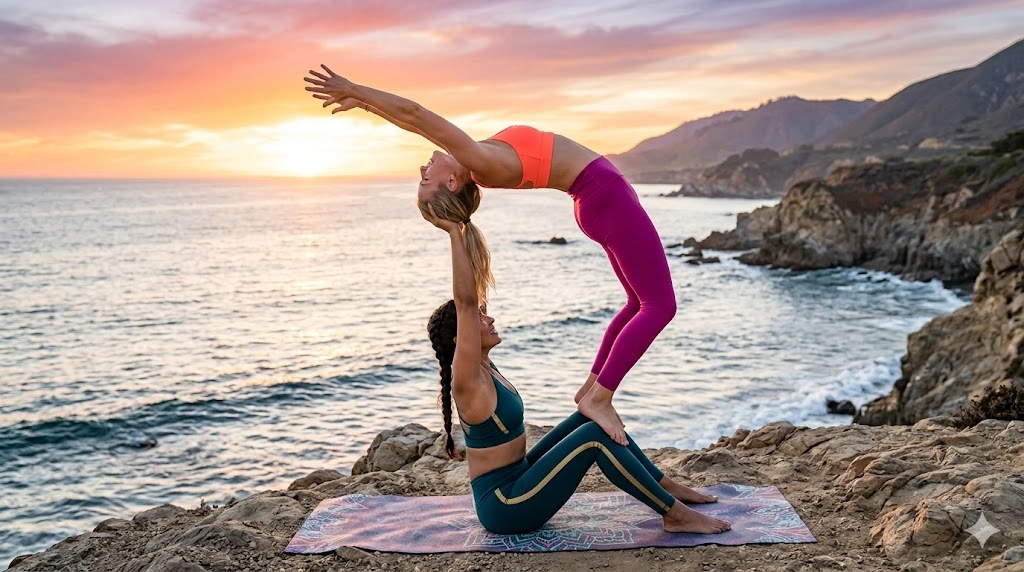
Two Person Yoga Poses
Two Person Yoga Poses—often known as partner yoga poses—have become one of the most rapidly expanding wellness and fitness practices in 2026. This style of yoga blends physical movement, synchronized breathing, emotional connection, and cooperative balance work between two individuals.
Unlike solo yoga practice, partner yoga requires collaboration. One participant often stabilizes the posture while the other performs stretching, lifting, or balancing movements. This cooperative interaction builds not only physical strength and flexibility but also trust, communication, and mental awareness.
Modern fitness is no longer limited to muscular appearance or calorie burning. Today, people are increasingly focused on emotional well-being, stress relief, and meaningful social connection. This is why two person yoga poses are becoming popular among couples, friends, family members, and even professional trainers.
In this comprehensive guide, you will explore:
- Definition and meaning of partner yoga
- Full benefits for body, mind, and emotions
- Step-by-step instructions for safe practice
- Beginner, intermediate, and advanced poses
- Safety guidelines and injury prevention
- Common mistakes to avoid
- Weekly structured training plan
- Scientific principles behind partner yoga
- Expert-level tips for faster progress
Let’s begin this complete transformation journey into the world of partner-based yoga training.
What Are Two Person Yoga Poses?
Two person yoga poses refer to structured yoga postures performed by two participants working in synchronization. These poses require coordination, balance sharing, and mutual physical support.
Typically, one person acts as a base (support structure) while the other acts as a flyer or active mover who performs stretching or balancing movements.
Both participants must work in harmony by aligning breathing patterns, movement timing, and body control.
Common Practice Environments
Partner Yoga is commonly practiced in:
- Yoga studios
- Home fitness routines
- Acro yoga training classes
- Couples wellness sessions
- Group bonding workshops
- Physical therapy or rehabilitation programs
Working Mechanism
The working principle is simple but powerful:
- One partner stabilizes the body
- The second partner performs controlled movement
- Both maintain synchronization in breathing
- Communication remains continuous throughout practice
This creates a deep connection between physical movement and emotional awareness.
Benefits of Two Person Yoga Poses
Partner yoga delivers a wide range of advantages that go far beyond standard physical exercise. It develops the entire human system—body, mind, and emotional stability.
Physical Benefits
Two person yoga poses improve physical performance in multiple ways:
- Enhances overall flexibility of the body
- Builds natural core strength without gym equipment
- Improves balance, posture, and spinal alignment
- Strengthens major muscle groups
- Develops coordination and body control
Emotional Benefits
This practice strongly influences emotional wellness:
- Builds trust between partners
- Strengthens communication ability
- Improves relationship bonding
- Reduces anxiety and emotional stress
- Encourages emotional stability and understanding
Mental Benefits
Partner yoga also enhances cognitive and mental functioning:
- Increases concentration and focus
- Improves mindfulness awareness
- Strengthens patience and discipline
- Reduces mental fatigue and overthinking
- Enhances body-mind coordination
Real-Life Impact
People practicing partner yoga regularly often experience:
- Healthier communication in relationships
- Improved emotional understanding
- Reduced dependence on gym-based workouts
- Increased relaxation and mental clarity
Science Behind Two Person Yoga Poses
The effectiveness of partner yoga is supported by neurological and physiological principles.
Neuromuscular Coordination
When two people coordinate movement, the nervous system adapts to shared balance patterns, improving reflex control and body awareness.
Proprioception Development
The body develops better awareness of position and movement in space, improving balance and reducing injury risk.
Stress Hormone Reduction
Consistent yoga practice lowers cortisol levels, which reduces stress and enhances emotional stability.
Mirror Neuron Activation
The brain activates mirror neurons that help synchronize movement patterns between two individuals, improving teamwork and connection.
Step-by-Step Guide to Practicing Partner Yoga Safely
Safe practice is essential for long-term benefits and injury prevention.
Warm-Up Together
Before starting any two person yoga poses:
- Rotate neck gently
- Move shoulders in circular motion
- Stretch hamstrings lightly
- Practice deep breathing together
Begin with Simple Movements
Avoid advanced acrobatic poses initially. Start with basic stretching and balancing exercises.
Maintain Clear Communication
Use simple verbal signals such as:
- “Slow down”
- “Hold position”
- “Breathe deeply”
- “Stop immediately”
Focus on Stability
- Engage core muscles
- Avoid sudden or jerky movements
- Maintain steady breathing rhythm
End with Relaxation
Finish practice with:
- Meditation in seated position
- Deep breathing exercises
- Lying relaxation pose
Proper Form & Alignment Principles
Correct alignment ensures safety and effectiveness:
- Maintain straight spine posture
- Engage abdominal muscles continuously
- Avoid locking knees or elbows
- Distribute body weight evenly
- Keep breathing steady and controlled
Proper alignment significantly improves performance and reduces injury risk.
Breathing Technique in Partner Yoga
Breathing synchronization is the foundation of partner Yoga Success.
Core Rules:
- Inhale during expansion movements
- Exhale during stretching phases
- Match breathing rhythm with partner
- Avoid breath holding for long durations
Synchronized breathing improves coordination and emotional bonding.
Muscles Worked in Two Person Yoga Poses
| Muscle Group | Effect |
| Core muscles | Stability and balance |
| Back muscles | Posture support |
| Legs | Strength and flexibility |
| Shoulders | Weight support |
| Arms | Control and lifting |
Levels of Two Person Yoga Poses
| Level | Type | Difficulty |
| Beginner | Stretching poses | Easy |
| Intermediate | Balance poses | Medium |
| Advanced | Acro yoga poses | Hard |
Beginner Two Person Yoga Poses
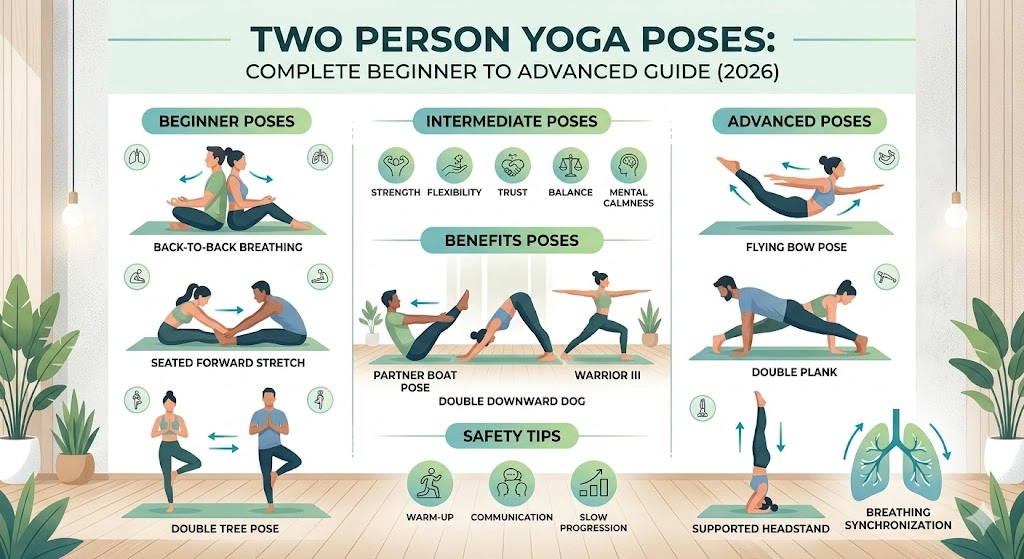
1. Back-to-Back Breathing Pose
Steps:
- Sit back-to-back
- Match breathing rhythm
- Relax shoulders completely
Benefits:
- Emotional relaxation
- Stress reduction
2. Seated Forward Stretch
Steps:
- Sit facing each other
- Hold hands firmly
- Lean forward gently
Benefits:
- Improved flexibility
- Muscle relaxation
3. Double Tree Pose
Steps:
- Stand side by side
- Support each other
- Lift inner leg slowly
Benefits:
- Balance improvement
- Focus enhancement
Intermediate Two Person Yoga Poses
4. Partner Boat Pose
- Sit facing each other
- Hold hands tightly
- Lift legs into V-shape
5. Double Downward Dog
- One Partner forms base position
- Second places feet on back
6. Partner Warrior III
- Lean forward together
- Balance on one leg
- Maintain hand support
Advanced Two Person Yoga Poses
7. Flying Bow Pose
Requires strong trust and controlled lifting technique.
8. Double Plank Challenge
One partner holds plank while second balances above.
9. Supported Headstand Pose
One partner assists inversion balance carefully.
Common Mistakes to Avoid
- Skipping warm-up sessions
- Poor communication between partners
- Attempting advanced poses too early
- Improper breathing control
- Practicing on hard or unsafe surfaces
Safety Tips for Two Person Yoga Poses
- Always use Yoga Mats
- Start slowly and progressively
- Avoid forcing flexibility
- Maintain communication
- Stop immediately if discomfort occurs
Who Should Avoid Partner Yoga
- Individuals with recent injuries
- People with severe back pain
- Those with balance disorders
- Joint-related medical conditions
- Pregnancy cases (advanced poses only)
Duration & Frequency Plan
- Beginners: 10–15 minutes daily
- Intermediate: 20–30 minutes
- Advanced: 2–4 sessions per week
Consistency is more important than intensity.
7-Day Partner Yoga Routine
Day 1–2: Breathing + light stretching
Day 3: Beginner balance poses
Day 4: Rest and recovery
Day 5: Intermediate training
Day 6: Mixed practice
Day 7: Meditation and relaxation
Pros & Cons of Two Person Yoga Poses
Advantages:
- Improves trust and bonding
- Enhances physical fitness
- Requires no equipment
- Fun and engaging practice
Disadvantages:
- Requires partner availability
- Learning curve for beginners
- Risk if performed incorrectly
Beginner vs Advanced Comparison
| Feature | Beginner | Advanced |
| Difficulty | Easy | Hard |
| Strength | Low | High |
| Flexibility | Basic | Advanced |
| Risk Level | Low | Medium |
FAQs
1. Are two person yoga poses safe for beginners?
Yes, they are safe when practiced slowly with proper guidance.
2. Do I need flexibility?
No, flexibility develops gradually through practice.
3. Can friends do partner yoga?
Yes, it is suitable for friends, not just couples.
4. How often should I practice?
3–5 times per week is recommended.
5. What surface is best?
A yoga mat or soft grassy surface is ideal.
Conclusion
Two Person Yoga Poses represent more than physical exercise—they are a holistic lifestyle discipline that improves the entire human experience.
Through consistent practice, individuals gain:
- Stronger physical structure
- Enhanced flexibility
- Better emotional bonding
- Improved mental clarity
- Greater trust and communication
Whether you are a beginner or advanced practitioner, partner yoga provides a meaningful journey of growth.
Start slowly, practice regularly, and enjoy the powerful connection that comes from moving together in harmony.
