
2 Person Yoga Poses
INTRODUCTION
2 Person Yoga Poses represent a highly interactive, cooperative, and synergistic form of physical training and mindful movement practice. Unlike solitary yoga sessions where the practitioner functions independently, partner-based yoga introduces a dual-system dynamic where two individuals engage in synchronized movement patterns, coordinated breathing cycles, and mutual physical stabilization techniques.
This discipline is often categorized under terms such as partner yoga, couple-based yoga training, or acrobatic yoga variations (commonly known as acro yoga at advanced stages). The fundamental principle is not only physical enhancement but also cognitive synchronization, emotional alignment, and trust-based biomechanical interaction.
In modern wellness environments, especially across global fitness communities, 2 person yoga poses are increasingly recognized as a hybrid between flexibility training, resistance conditioning, and interpersonal communication development.
This comprehensive NLP-structured guide is designed to systematically support:
- Absolute beginners with zero yoga exposure
- Intermediate practitioners seeking progression
- Advanced athletes exploring acrobatic yoga systems
- Couples and partners aiming for connection-based fitness
You will learn:
Step-by-step pose execution
Anatomical alignment guidance
Breathing synchronization protocols
Injury prevention frameworks
Progressive training structure
Full partner yoga routine design
The goal of this guide is to provide a complete transformational pathway from basic movements to advanced coordinated yoga systems.
WHAT ARE 2 PERSON YOGA POSES?
2 Person Yoga Poses are structured physical postures performed collaboratively by two individuals who act as interconnected support systems for each other’s movement execution, balance maintenance, and flexibility enhancement.
A dyadic motor coordination system involving shared proprioceptive control, reciprocal force distribution, and synchronized postural alignment.
These poses require:
- Mutual body awareness
- Coordinated movement timing
- Controlled breathing alignment
- Shared physical stabilization
Core Functional Components
1. Mutual Structural Support
Each participant contributes to equilibrium maintenance by acting as both stabilizer and mobilizer.
2. Synchronized Respiratory Flow
Breathing is aligned in a rhythmic pattern to improve neuro-muscular coherence.
3. Communication-Based Execution
Verbal and non-verbal cues regulate movement transitions and safety.
4. Postural Symmetry Awareness
Both practitioners maintain biomechanical alignment to prevent strain.
WHY 2 PERSON YOGA IS UNIQUE
Unlike isolated Yoga Practice, partner yoga introduces an external feedback loop where each participant becomes both a performer and a stabilizing mechanism for the other.
This results in:
- Enhanced range of motion through assisted stretching
- Increased muscular resistance through dual loading
- Improved balance via external stabilization points
- Strengthened interpersonal trust mechanisms
BENEFITS OF 2 PERSON YOGA POSES
Physical Benefits
- Enhanced muscular elongation through assisted flexibility
- Increased joint mobility and articulation efficiency
- Core stabilization improvement through dual resistance loading
- Improved neuromuscular coordination patterns
- Postural correction through mirrored alignment feedback
Cognitive & Mental Benefits
- Reduced psychological stress through synchronized breathing
- Enhanced mindfulness via shared attention focus
- Increased concentration stability
- Improved body-mind awareness integration
- Strengthened mental discipline through cooperative effort
Emotional & Social Benefits
- Trust-building through controlled physical dependency
- Enhanced interpersonal communication systems
- Strengthened relational bonding mechanisms
- Increased confidence in shared movement environments
WARM-UP SEQUENCE
Before executing any 2 Person Yoga Poses, a structured warm-up phase is essential to activate muscle groups, prepare joints, and synchronize breathing patterns.
1. Back-to-Back Breathing Synchronization
Execution Steps:
- Sit in a cross-legged position with dorsal contact
- Align spinal curvature vertically
- Relax shoulder girdle completely
- Initiate synchronized inhalation and exhalation cycles
Respiratory Pattern:
y=sin(x)y = \sin(x)y=sin(x)
- Inhale phase → thoracic expansion + oxygen intake
- Exhale phase → muscular relaxation + tension release
Functional Outcomes:
- Nervous system regulation
- Emotional stabilization
- Postural awareness enhancement
BEGINNER 2 PERSON YOGA POSES
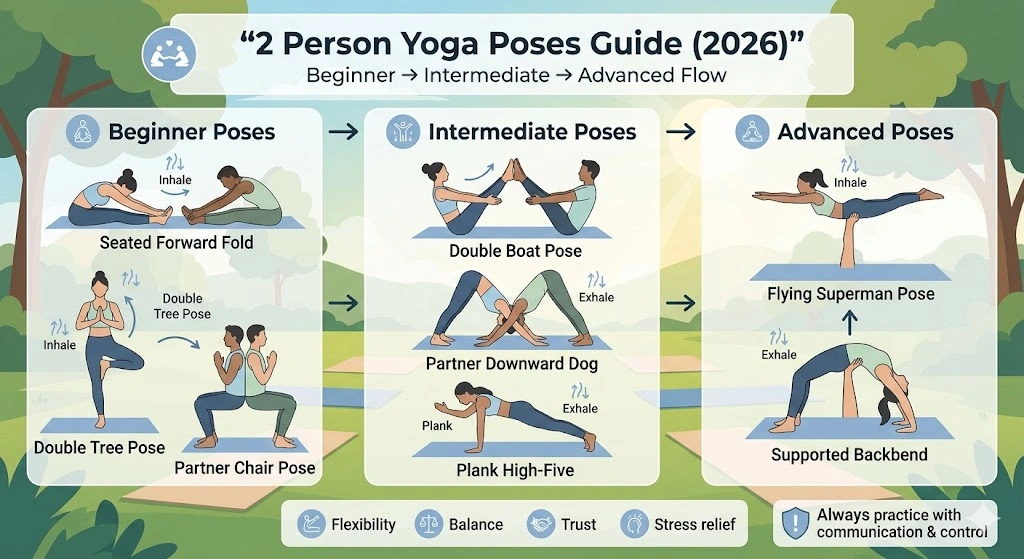
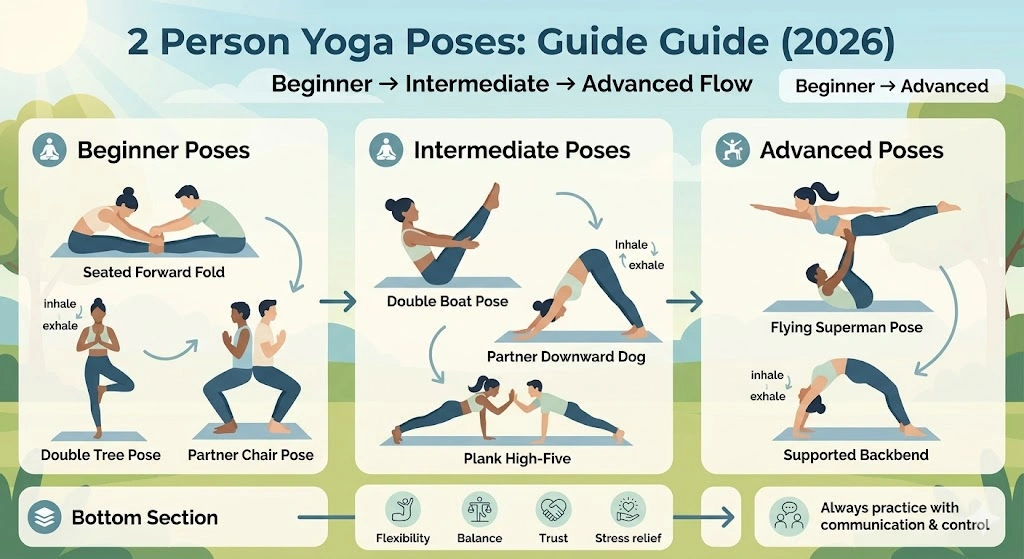
1. Seated Forward Fold Partner Stretch
Execution Protocol:
- Both partners sit facing each other
- Establish wrist or forearm connection
- One partner initiates forward trunk flexion
- Second partner provides counter-support resistance
Targeted Muscle Groups:
- Hamstring chain
- Lumbar spinal region
2. Double Tree Pose
Steps:
- Stand side-by-side in parallel orientation
- Engage mutual arm support linkage
- Lift outer lower limb into unilateral balance stance
Outcomes:
- Balance optimization
- Lower limb strength development
- Neuromuscular coordination improvement
3. Partner Chair Pose (Shared Load Bearing)
- Back-to-back positioning
- Simultaneous knee flexion descent
- Static hold under shared load distribution
Muscles Activated:
- Quadriceps group
- Gluteal region
- Core stabilizers
4. Double Child’s Pose (Passive Recovery Mode)
- One participant enters restorative flexion posture
- Second participant applies gentle overlay support
Benefits:
- Spinal decompression
- Stress reduction
- Deep relaxation induction
INTERMEDIATE 2 PERSON YOGA POSES
5. Double Boat Pose (Core Synchronization System)
Participants face each other, interlock hands, and elevate lower limbs to form a V-shaped biomechanical structure.
y=x2y = x^2y=x2
Functional Outcome:
- Core muscle hypertrophy stimulation
- Hip flexor activation
- Balance coordination refinement
6. Double Downward Dog (Inverted Support Chain)
- One partner assumes inverted V structure
- Second partner introduces foot-based stabilization
Benefits:
- Upper body strength enhancement
- Shoulder girdle activation
- Full kinetic chain stretching
7. Partner Plank High-Five Coordination Drill
- Both partners maintain plank position
- Alternating unilateral arm elevation for interaction
Outcome:
- Core endurance
- Stability under dynamic load
- Cognitive-motor synchronization
ADVANCED 2 PERSON YOGA POSES
8. Flying Superman Pose (Aerial Stability Model)
- Base partner provides grounded support
- Flyer achieves horizontal extension alignment
Outcomes:
- Full-body kinetic activation
- Trust-based load transfer
- Advanced balance control
9. Standing Backbend Support System
- One partner performs Spinal Extension
- Second partner provides controlled lumbar support
Benefits:
- Thoracic expansion
- Spinal flexibility
- Mobility enhancement
PROGRESSION STRUCTURE
| Level | Pose Category | Focus |
| Beginner | Forward Fold, Tree | Flexibility & balance |
| Intermediate | Boat, Downward Dog | Strength & stability |
| Advanced | Flying Superman | Trust & control |
BREATHING SYNCHRONIZATION MODEL
Breathing is the central regulatory mechanism in partner yoga.
Pattern:
- Inhale → expansion phase
- Exhale → contraction and deepening phase
This improves:
- Parasympathetic activation
- Emotional equilibrium
- Movement coordination
COMMON ERRORS
- Rapid transition into advanced postures
- Lack of verbal communication protocols
- Misaligned spinal positioning
- Excessive force application
- Unsafe surface selection
SAFETY FRAMEWORK
- Maintain continuous communication loop
- Avoid force-based stretching
- Ensure equal skill compatibility
- Use non-slip yoga surface
- Stop immediately upon discomfort signals
SCIENTIFIC MECHANISMS
Partner yoga activates:
- Proprioceptive sensory feedback loops
- Mirror neuron activation systems
- Neuromuscular synchronization pathways
This enhances both physical and emotional coordination.
CONCLUSION
2 Person Yoga Poses represent a multidimensional training system that integrates biomechanics, emotional intelligence, and synchronized movement execution.
From beginner-level assisted stretching to advanced acrobatic coordination, this practice builds:
- Physical strength
- Flexibility
- Trust
- Communication
- Cognitive alignment
Consistent practice leads to progressive improvement in both physical capability and interpersonal synchronization.
Begin with foundational poses, progress gradually, and maintain structured practice discipline for optimal transformation results.
