
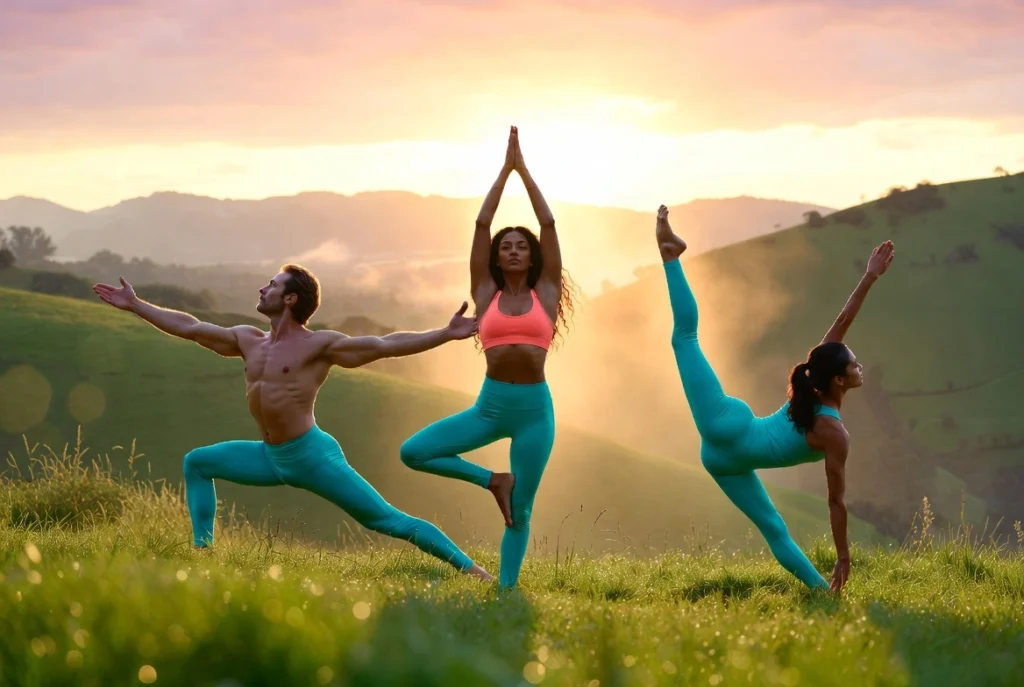
Ultimate Guide to 3 People Yoga Poses
Introduction: Why 3 People Yoga Holds Significance
Yoga is commonly considered an introspective pursuit — a voyage of inhalation, posture, and inner consciousness. However, practicing 3 People Yoga Poses (often referred to as trio yoga postures) introduces an entirely novel dimension to your asana experience. Engaging in trio yoga with three individuals simultaneously cultivates physical fortitude, enhanced equilibrium, and mutual reliance.
These sequences transcend simple stretching or balance — they emphasize team synergy, communication, and interconnected energy. Practicing yoga in a trio setting fosters joyful, collaborative engagement, whether in a studio environment, during retreats, or while journeying across European destinations.
Whether you’re visiting a yoga studio in Berlin, joining a retreat in Spain, or practicing by the seashore in Portugal, trio yoga enriches your routine with playful yet stimulating elements. This guide is crafted to help you progress safely from beginner to advanced, optimize trio alignment, and embrace Europe-centric yoga experiences.
By the conclusion, you’ll possess the competence to orchestrate a three-person yoga session with confidence, stability, and synchrony, unlocking benefits for body, mind, and group cohesion.
What Are 3 People Yoga Poses?
3 people yoga poses are sequences specifically designed to be executed collectively by three practitioners. Unlike duo or partner yoga, trio yoga necessitates:
- Shared equilibrium and weight management
- Coordinated timing and verbal/non-verbal communication
- Intensified core engagement
- Mutual mindfulness and trust
These postures integrate yogic alignment principles, acrobatics, mindfulness practices, and harmonized movement, making them ideal for friends, couples, and small-group yoga sessions.
Benefits of Practicing 3 People Yoga
Physical Advantages
- Strengthens core stability and postural alignment
- Activates multiple muscle groups across the upper and lower body simultaneously
- Improves kinesthetic awareness and proprioception
- Enhances overall suppleness and flexibility
Mental & Emotional Advantages
- Fosters interpersonal trust and cooperative teamwork
- Synchronizing inhalation and exhalation enhances focus and mindfulness
- Diminishes stress through group connection
- Cultivates empathy, social bonding, and emotional awareness
Cultural & Travel Advantages
Integrating trio yoga into European experiences — such as group workshops in Amsterdam, retreats in Spain, or festival yoga sessions in Portugal — allows practitioners to merge physical discipline with cultural immersion, enriching both mind and spirit.
Trio Yoga Safety & Best Practices
Safety is paramount when coordinating three bodies in motion. Prioritize the following before attempting any posture:
Safety Recommendations
- Initiate with a Dynamic Warm-up, including joint rotations and mobility exercises
- Assign specific roles: base, support, flyer
- Ensure clear, unobstructed floor space and adequate mats
- Begin with low-difficulty poses and progress gradually
- Modify poses according to individual flexibility, experience, or limitations
Contraindications
Avoid trio yoga practice if any participant has:
- Recent surgical procedures or injuries
- Acute or chronic back/neck conditions
- Vestibular or balance disorders
- Excessive joint hypermobility
Tip: Seek professional guidance from a healthcare provider before attempting advanced postures.
Beginner 3 People Yoga Poses
Start your trio yoga journey with these approachable and beginner-oriented sequences.
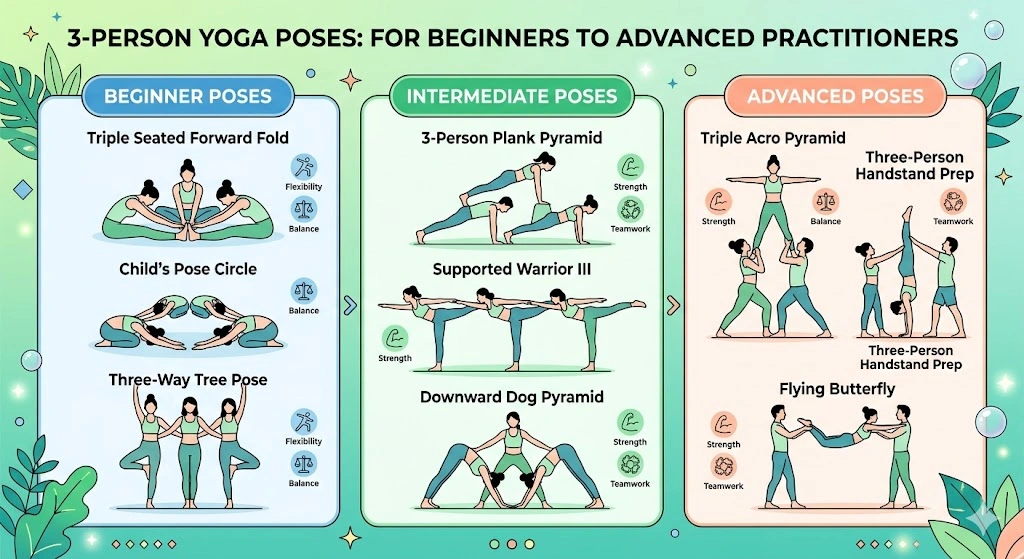
1. Triple Seated Forward Fold
Procedure:
- Sit in a circular formation with extended legs.
- Each participant grasps the hands of neighbors.
- Inhale to elongate the spine; exhale to fold forward gently.
- Maintain posture for 5–8 breaths.
Advantages: Stretches hamstrings, releases spinal tension, enhances group cohesion
Muscles Targeted: Hamstrings, lumbar region, shoulders
2. Triple Child’s Pose Circle
Procedure:
- Sit in a circle facing inward.
- Fold forward into Child’s Pose, forehead resting comfortably.
- Extend arms toward the circle center.
- Inhale and exhale together, holding for 8 breaths.
Advantages: Induces relaxation, promotes synchronized breathing, relieves stress
Common Pitfall: Forcing forehead to floor — maintain comfort and flexibility
3. Three-Way Tree Pose
Procedure:
- Stand in a triangular formation.
- Hold hands with both fellow participants.
- Lift one leg and place the foot on inner calf or thigh (avoid knees).
- Hold for 5 breaths, then switch sides.
Advantages: Enhances balance, strengthens ankles and legs
Muscles Targeted: Calves, glutes, core stabilizers
Intermediate Trio Yoga Poses
After mastering beginner postures, incorporate these more challenging sequences:
1. 3-Person Plank Pyramid
Steps:
- Person A assumes a stable plank (base).
- Person B positions feet on A’s upper back and hands on floor.
- Person C positions feet on B’s back with hands grounded.
- Hold for 10–20 seconds.
Advantages: Improves core endurance, shoulder stability, coordination
Precaution: Avoid if wrist or shoulder discomfort exists
2. Supported Warrior III Trio
Steps:
- Two practitioners adopt Warrior III stance side by side.
- Third participant offers balance support in front.
- Synchronize alignment and breathing.
Advantages: Boosts posture, strengthens legs, fosters teamwork
3. Downward Dog Pyramid
Steps:
- Two individuals form Downward Dog.
- Third participant balances lightly on their backs.
- Hold for 3–5 breaths.
Safety Tip: Communicate weight shifts slowly and clearly
Advanced Trio Yoga Poses (Acro-Inspired)
Advanced poses require significant strength, flexibility, and trust.
1. Triple Acro Pyramid
Steps:
- Base forms a firm seated or plank foundation.
- Middle participant layers above the base.
- Third participant assumes top position.
- Adjust alignment carefully before lifting.
Focus: Breathing coordination, communication
2. Three-Person Handstand Prep
Steps:
- One individual supports against the wall.
- Second assists by stabilizing the legs.
- Third participant balances with guidance.
Safety: Use spotters; lift gradually
Benefits: Refines balance, strengthens shoulders
3. Flying Butterfly (Supported)
Steps:
- Base lies supine with knees bent.
- Middle participant stands behind the base.
- Flyer balances on middle’s shoulders with support.
Safety Tip: Place blocks or bolsters nearby
3 People Yoga Flow Sequence
| Sequence Part | Pose | Duration |
| Warm-up | Joint rotations & breath | 3–5 min |
| Flow 1 | Triple Seated Forward Fold | 7 breaths |
| Flow 2 | Tree Pose (each side) | 10 breaths |
| Strength | Plank Pyramid | 15–20 sec |
| Balance | Downward Dog Pyramid | 5 breaths |
| Cool-down | Child’s Pose Circle | 5 breaths |
Tip: Move slowly and communicate transitions clearly
Breathing Techniques (Pranayama) for Trio Yoga
Ujjayi Breath (Ocean Sound Breath)
- Inhale through nose, gently constricting throat
- Exhale through nose with soft ocean-like sound
- Synchronize inhalation/exhalation as a group
Equal Breath (Sama Vritti)
- Inhale for 4 counts
- Optional hold for 4 counts
- Exhale for 4 counts
Science & Philosophy Behind Trio Yoga
Trio Yoga fosters sangha (community support) via:
- Oxytocin release through synchronized breathing
- Enhanced motor learning through mirroring partners
- Heightened proprioception and body awareness
Yoga philosophy — encompassing yama, niyama, asana, pranayama, and samadhi — is amplified in group settings, offering enriched physical and psychological benefits.
Common Mistakes to Avoid
| Mistake | Correction |
| Rushing into advanced poses | Warm-up thoroughly |
| Poor communication | Agree on signals & cues |
| Ignoring breath | Slow, synchronized inhalation/exhalation |
| Unstable base | Adjust stance and alignment first |
Tips for Beginners
- Begin with simple, low-risk postures
- Use padded surfaces for safety
- Incorporate yoga blocks, straps, bolsters
- Keep early sessions short
Duration & Frequency
| Level | Duration | Frequency |
| Beginner | 15–30 min | 2–3×/week |
| Intermediate | 30–45 min | 3×/week |
| Advanced | 45–60 min | 3–5×/week |
Trio Yoga & Europe Travel Recommendations
- Spain: Beach sunrise trio sessions
- Italy: Sunset vineyard yoga
- Germany: Studio flows in Berlin
- Netherlands: Outdoor park yoga in Amsterdam
Engage with local yoga communities for cultural immersion and enhanced travel experience.
3 People Yoga Pose Progression Table
| Level | Poses Included | Focus |
| Beginner | Triple Seated Forward Fold, Child’s Pose Circle | Flexibility & ease |
| Intermediate | Plank Pyramid, Warrior III | Strength & balance |
| Advanced | Handstand Prep, Acro Pyramid | Power & precision |
FAQs
Yes, provided participants communicate, progress gradually, and warm up appropriately.
Mats, optional straps, blocks, and sufficient clear space.
Absolutely — parks, beaches, and festivals across Europe are ideal.
Yes — advanced trio postures require prior solo yoga proficiency.
Use clear verbal cues like “lift,” “steady,” “release,” or hand signals.
Conclusion
Three-Person Yoga introduces a rich, multifaceted dimension to your practice — physically, mentally, and socially. From gentle seated stretches to sophisticated acro balances, trio yoga nurtures strength, coordination, breath harmony, and trust.Whether practicing in a studio in Europe, at home, or on a scenic beach, these poses deepen your connection to both your body and companions. Start gradually, communicate consistently, synchronize your breath, and embrace patience and mindfulness as essential tools for a safe and enriching experience.
