
Standing Yoga Asanas
Introduction: Why Standing Yoga Asanas Are the Foundation of Modern Practice
Throughout Europe, the Standing Yoga Asanas are the structural support of virtually all modern yoga sessions, be it in a tiny wellness studio in Barcelona or the minimalist domestic yoga in Berlin. These upright positions develop the strength of the muscles, stability of the pose, mobility of the joints, neuromuscular control, and clarity of mind, whether you are a beginner stepping on the mat for the first time or a professional polishing technique.
These poses are exceptionally powerful because they:
- Develop functional, real-world strength
- Enhance structural alignment
- Stimulate blood circulation
- Improve equilibrium and coordination
- Prepare the body for advanced transitions
- Increase joint resilience
- Build endurance and muscular stamina
What Are Standing Yoga Asanas?
Standing yoga asanas are upright postures which are done by balancing one or both feet. They are the classical elements of Hatha Yoga Pradipika teachings and are popularly incorporated in the modern teachings of Vinyasa-based sequencing, based on classical teachings like the yoga sutras of Patanjali.
Sthira and Sukha are two concepts in the yogic philosophy that provide the perfect posture. Standing cultivates dynamicity and relaxation of stability.
Core Characteristics
- Carrying on the feet and legs.
- The hamstring, gluteal, and quadriceps are involved.
- Deep core stabilization
- Spinal lengthening through axial lift
- Breath-synchronized movement patterns
- Neuromuscular integration
- Joint alignment awareness
Standing yoga asanas teach grounding and embodiment. They train you to remain centered even when challenged physically or mentally.
Why Standing Yoga Asanas Are Essential for Modern European Lifestyles
Most people in Europe and North America spend a large part of their time sitting behind workstations, in cars, or on couches. As a result of sedentary habits, there is:
- Underactive gluteal muscles
- Tight hip flexors
- Rounded thoracic spine
- Weak posterior chain
- Reduced circulation
- Lower back discomfort
- Limited ankle mobility
These dysfunctions are directly reversed by standing yoga asanas. They wake up big muscle masses, energize circulation, reestablish posture, and retrain posture.
Neuromechanically, the upright poses increase proprioceptive feedback, which is the system of body position. This enhances efficiency in coordination and movement in the day-to-day activities such as walking, climbing stairs, and lifting objects.
Physical Benefits of Standing Yoga Asanas
1. Full-Body Strength Development
Standing poses generate compound muscular activation. They strengthen:
- Quadriceps
- Hamstrings
- Gluteus maximus and medius
- Gastrocnemius and soleus
- Transverse abdominis
- Erector spinae
For example:
Warrior II develops endurance of the lower body and the hip.
Chair Pose strengthens thigh strength and the stability of the pelvis.
Mountain Pose involves the use of intrinsic postural muscles.
Through repetitive exercise, muscular tone is enhanced, joint structural integrity is enhanced, and structure is strengthened.
2. Improved Balance & Proprioception
Single-leg positions like Tree Pose are a challenge to the neuromuscular coordination and the vestibular functions. These poses activate mechanoreceptors on the feet and ankles, which improves the sensory-motor integration.
Benefits include:
- Better coordination
- Faster reaction time
- Reduced fall risk
- Increased athletic performance.
- Enhanced ankle stability
Balance training also develops particular importance with age since neuromuscular efficiency is actually decreases with age.
3. Better Posture
Modern postural deviations frequently include:
- Forward head position
- Kyphotic upper back
- Collapsed medial arches
- Anterior pelvic tilt
Organic stance yoga practices rehabilitate alignment. Mountain Pose (Tadasana) is a blueprint of a position. It corrects the skeletal system and strengthens supportive muscles when practiced correctly.
Habitual posture outside the yoga studio is also better with time.
4. Increased Flexibility
Standing postures lengthen and mobilize:
- Hamstrings (Forward Fold)
- Hip flexors (Warrior I)
- Adductors (Triangle Pose)
- Calves and Achilles tendon
- Thoracic spine
Elasticity is built up gradually with load control and isometric positioning. Stability generates quantifiable improvements in the extent of motion.
Mental & Nervous System Benefits
The yoga asanas do not affect muscles and joints only. They control the autonomic nervous system.
They:
- Improve concentration
- Reduce cortisol levels
- Increase the interoceptive awareness.
- Enhance mind-body interaction.
- Promote emotional control.
There is a need to strike a balance between postures, which require attention. In case the mind is wandering, stability is reduced. This develops self-awareness and awareness of the present.
Meditative breathing activates the parasympathetic system, which helps in relaxing and cuts physiological stress.
Step-by-Step Guide to Essential Standing Yoga Asanas
Below is a detailed breakdown of foundational postures.
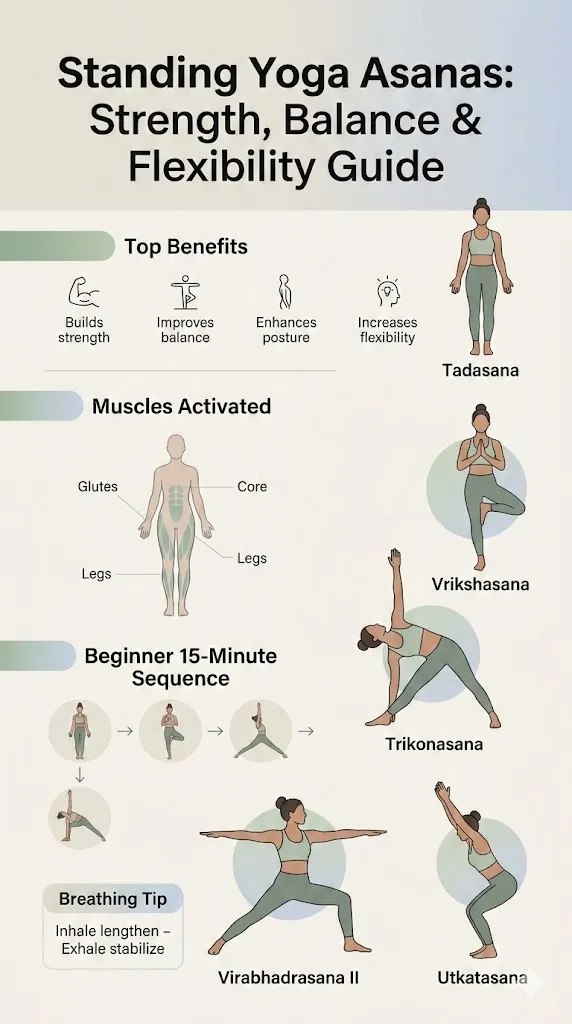
1. Tadasana (Mountain Pose)
How to Do It
- Stand upright with feet hip-width apart.
- Distribute weight evenly across both feet.
- Spread toes for stability.
- Engage quadriceps gently.
- Lengthen through the spine.
- Relax your shoulders downward.
Breathing
- Inhale: elongate upward
- Exhale: root through the feet
Muscles Targeted
- Quadriceps
- Core stabilizers
- Postural muscles
Mountain Pose establishes alignment awareness and foundational engagement.
2. Vrikshasana (Tree Pose)
Steps
- Shift weight onto one leg.
- Place the opposite foot on the inner calf or thigh.
- Avoid pressing into the knee joint.
- Bring palms together or raise arms overhead.
- Fix gaze on a stable point (drishti).
Benefits
- Enhances balance
- Strengthens ankles
- Improves focus
- Builds hip stability
3. Trikonasana (Triangle Pose)
Steps
- Take a wide stance.
- Extend arms parallel to the floor.
- Hinge at the hip joint.
- Lower front hand to shin or block.
- Lift the opposite arm upward.
Alignment Tip
Maintain chest openness and avoid collapsing forward.
The triangle pose increases lateral flexibility and strengthens the legs simultaneously.
4. Virabhadrasana II (Warrior II)
How to Practice
- Bend the front knee to approximately 90 degrees.
- Keep the back leg straight and strong.
- Extend arms actively.
- Gaze over the front fingertips.
Benefits
- Builds lower-body strength
- Improves hip mobility
- Increases stamina
- Enhances concentration
5. Utkatasana (Chair Pose)
Steps
- Bend knees deeply.
- Shift hips backward.
- Raise arms overhead.
- Lift chest without overaching.
Muscles Activated
- Quadriceps
- Glutes
- Core
Chair Pose develops muscular endurance and pelvic control.
Comparison Table – Beginner vs Intermediate vs Advanced Standing Poses
| Level | Example Poses | Balance Demand | Strength Required | Flexibility Needed |
| Beginner | Tadasana, Chair | Low | Moderate | Low |
| Intermediate | Triangle, Warrior II | Moderate | Moderate | Moderate |
| Advanced | Warrior III, Revolved Triangle | High | High | High |
This framework helps practitioners select appropriate challenges.
Proper Form & Alignment Principles
Correct biomechanical alignment prevents injury and enhances effectiveness.
Alignment Checklist
- Knees track over the second toe
- Neutral spine maintained
- Core gently activated
- Shoulders relaxed
- Weight evenly distributed
Precise positioning protects joints and maximizes muscular engagement.
Breathing Technique for Standing Yoga Asanas
Use controlled diaphragmatic breathing or Ujjayi breath in dynamic flows.
- Inhale: lengthen
- Exhale: stabilize
Maintain a steady rhythm without strain. Breath continuity supports endurance and calm focus.
Muscles Targeted in Standing Yoga Asanas
| Muscle Group | Function |
| Quadriceps | Knee stabilization |
| Glutes | Hip stability |
| Hamstrings | Hip extension |
| Calves | Balance control |
| Core | Spinal protection |
These muscles support essential daily movements and athletic performance.
Variations for All Levels
Beginner Modifications
- Use yoga blocks
- Practice near a wall
- Shorten stance
- Reduce hold duration
Intermediate Progressions
- Add binds
- Increase hold time
- Slow transitions
Advanced Options
- Revolved variations
- Single-leg balances
- Dynamic transitions
Progress gradually to avoid overloading joints.
Common Mistakes to Avoid
- Locking knees
- Collapsing arches
- Overarching lumbar spine
- Holding breath
- Rushing transitions
Mindful execution prevents strain.
Safety Tips & Contraindications
Modify or avoid intense standing yoga asanas if you have:
- Recent knee injury
- Severe lower back pain
- Vertigo
- Uncontrolled hypertension
Consult a healthcare professional before beginning new exercise programs.
Clothing Considerations for Stability & Comfort
Apparel influences performance and proprioception.
Many practitioners prefer:
- Moisture-wicking materials
- Compression fabrics
- Four-way stretch textiles
Some choose the tightest yoga pants because they:
- Enhance muscle awareness
- Provide gentle compression
- Reduce distraction
- Support alignment feedback
Select a fabric weight appropriate for European climate conditions.
Duration & Frequency Recommendations
For optimal outcomes:
- Practice 3–5 times weekly
- Hold each posture 5–8 breaths
- Commit 15–30 minutes daily
- Combine upright poses with seated and supine work
Consistency creates adaptation and long-term progress.
Sample Beginner Standing Yoga Sequence
15-Minute Flow
- Tadasana – 5 breaths
- Raised Arms – 5 breaths
- Forward Fold – 5 breaths
- Tree Pose – 5 breaths each side
- Warrior II – 5 breaths each side
- Chair Pose – 5 breaths
- Return to Mountain
Repeat once or twice.
Yoga Philosophy Behind Standing Asanas
Standing Poses embody the equilibrium between effort and ease described in the Yoga Sutras of Patanjali.
From a scientific viewpoint, these postures:
- Improve circulation
- Activate stabilizing musculature
- Strengthen neural pathways
- Enhance musculoskeletal durability
They cultivate discipline, patience, and embodied awareness.
Pros & Cons of Standing Yoga Asanas
Pros
Develops total-body strength
Improves posture
Enhances balance
Builds endurance
Suitable for all levels
Cons
May strain knees if misaligned
Challenging for those with balance disorders
Requires a stable mat surface
FAQs About Standing Yoga Asanas
Yes. Start with Mountain, Tree, and Chair.
3–5 times per week is ideal.
Yes. They strengthen spinal stabilizers and improve alignment awareness.
Wear breathable, flexible clothing. Many prefer the tightest yoga pants for stability.
Yes. Use a non-slip mat and a safe space.
Final Words
Standing Yoga Poses constitute the structural base of effective yoga. They strengthen muscles, improve posture, improve neuromuscular control, and develop mental steadiness.
In France, in Germany, in Spain, in Italy, and at home, these erect positions give us a universal platform of power and stasis.
Standing yoga asanas will change your body, posture, evenness, stamina, and inner knowledge in the years to come with discipline and consistency.
