
Standing Position Yoga
In contemporary Europe, as well as all over the United States, the United Kingdom, Germany, Italy, Canada, and Australia, standing position yoga has not been merely a Stretching Exercise. Millions of people nowadays use yoga to become strong with their muscles, strengthen their back, be flexible, and be capable of controlling their emotions and enhancing joints, which is long-term strength.
Standing position yoga is one of the numerous types of yoga that constitute the physical development foundation. The studies presented and confirmed by such institutions as the National Institutes of Health prove yoga to improve strength, flexibility, and stability. Similarly, the study mentioned by Harvard Medical School indicates the application of yoga in preventing falls and musculoskeletal diseases.
Standing yoga is a distinctive modality that is a combination of strength, mobility, and balance. Regardless of whether you are doing the study in a studio in London, on your own in Berlin, study online in Toronto, this all-inclusive manual will enable you to learn, practice, and master standing position yoga clearly and safely.
What Is Standing Position Yoga?
Standing position yoga is a form of yoga that is performed in an upright form where the body is supported by the feet. In classical systems, such poses are quite noticeable, e.g., some are:
- Hatha Yoga
- Vinyasa Yoga
- Ashtanga Yoga
- Power Yoga
Recruitment of the larger muscles, adaptive weight-bearing, and neuromuscular coordination are involved in the standing poses as opposed to supine or seated poses, which involve activation of adaptations and recruitment of a greater mass of muscle.
- Standing yoga postures:
- Engage large lower body muscles.
- Strengthen functional abilities.
- Enhance proprioception and coordination.
- Make the skeletal structures stronger.
- Reinforce postural alignment
In applied physiology terms, standing yoga integrates isometric contraction, eccentric control, and postural stabilization in one integrated movement pattern.
It is not merely stretching—it is functional movement training disguised within mindful sequencing.
Why Standing Position Yoga Is Essential in Modern Lifestyles
The modern city life is dominated by sedentary living. Long sitting, whether in Paris, Amsterdam, Dublin, or New York, is likely to bring about:
- Inhibited gluteal activation
- Shortened hip flexors
- Thoracic kyphosis (rounded upper back)
- Lumbar discomfort
- Reduced core stability
Standing Yoga directly suits these dysfunctions.
Via regulated lunges, erect balances, and congruent positions, practitioners:
- Strengthen the posterior chain
- Lengthen the anterior hip structures
- Engage deep abdominal stabilizers
- Promote spinal elongation
- Restore kinetic efficiency
According to a movement scientific worldview, standing yoga restores closed-chain movement patterns that are necessary to walk, climb stairs, pick up something, and stand straight.
In more simple term: standing yoga re-trains your body to live.
Powerful Benefits of Standing Position Yoga
Physical Benefits
- Improves Balance & Stability
- Standing yoga improves neuromuscular integration. Muscles activated include
- Ankle stabilizers
- Deep transverse abdominis
- Gluteus medius
- Intrinsic foot musculature
Balance training enhances proprioceptive feedback systems and decreases the risk of falls- it is especially crucial in older individuals.
- Builds Functional Strength
- The following poses are developed: Chair Pose, variations of Warrior postures, and Crescent Lunge.
- Quadriceps strength
- Hamstring control
- Gluteal endurance
- Core activation
Contrary to individual gym apparatus, standing yoga develops the combined strength of multiple joints at a given moment.
Enhances Posture
Standing postures teach:
- Neutral pelvic positioning
- Scapular stabilization
- Cervical alignment
- Rib cage control
For individuals experiencing forward head posture or rounded shoulders, these alignment principles are corrective.
Improves Circulation
Dynamic standing sequences elevate heart rate and stimulate:
- Blood circulation
- Oxygen transport
- Lymphatic drainage
Mental & Emotional Benefits
Standing Yoga also supports psychological well-being.
It:
- Strengthens concentration
- Builds emotional resilience
- Reduces stress markers
- Increases interoceptive awareness.
Any minor distraction would cause disequilibrium in Tree Pose. This brings the realization of the present and the stability of mind.
Studies carried out in universities like the National Institutes of Health and Harvard Medical School have shown that yoga helps in the regulation of the mind, anxiety symptoms, and improves cognitive ability.
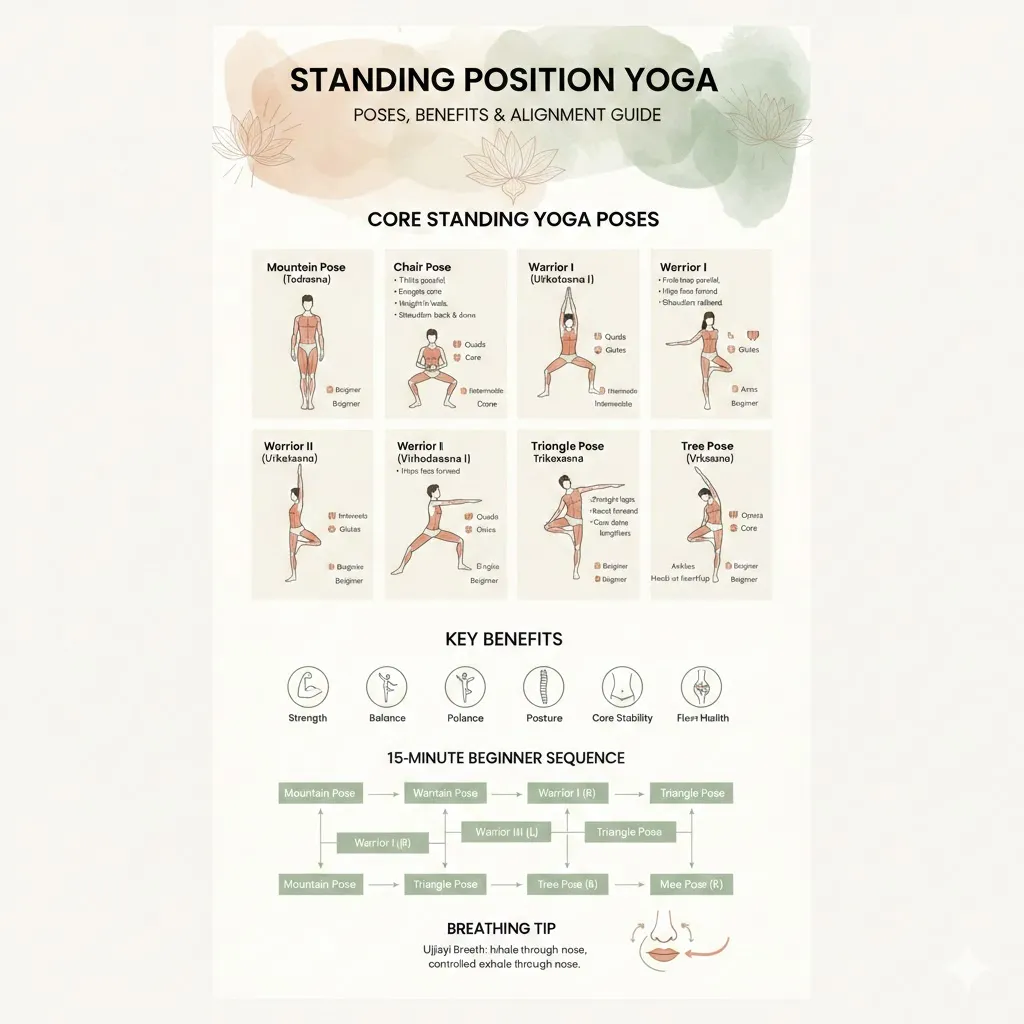
Core Standing Position Yoga Poses
Mountain Pose (Tadasana)
Mountain Pose is the anatomical blueprint for all standing postures.
Instructions:
- Bend with the feet at hip distance.
- Disperse toes to the mat.
- Also, use the quadriceps without locking the knees.
- Lengthen spine vertically.
- Shoulders relaxed down.
- Breathe slowly via the nose.
Muscles Activated:
- Core stabilizers
- Quadriceps
- Spinal extensors
Benefits:
- Reinforces postural awareness
- Develops alignment intelligence
- Improves weight distribution
Although visually simple, Mountain Pose demands precise muscular engagement.
Chair Pose (Utkatasana)
Chair Pose is a compound lower-body strengthening posture.
Steps:
- From Mountain Pose, bend knees deeply.
- Shift hips posteriorly as if sitting.
- Raise arms overhead.
- Keep chest lifted and spine neutral.
Muscles Targeted:
- Quadriceps
- Gluteus maximus
- Core stabilizers
Common Alignment Error:
Knees collapsing inward
Knees track over the second toes
Chair Pose builds endurance and stimulates metabolic demand.
Warrior I
Warrior I integrates hip extension and shoulder elevation.
Instructions:
- Step one foot backward.
- Bend the front knee to 90 degrees.
- Lift arms overhead.
- Square hips forward.
Benefits:
- Stretches hip flexors
- Strengthens the front thigh
- Improves shoulder mobility
Warrior II
Alignment Cues:
- Front knee aligned above the ankle
- Back leg fully extended
- Gaze over the front fingertips
This posture develops muscular stamina and hip strength.
Triangle Pose
The triangle pose emphasizes lateral flexion and hamstring extension.
Key Points:
- Straight legs without hyperextension
- Hinge from the hip joint
- Open the chest toward the ceiling
Triangle improves thoracic mobility and posterior chain flexibility.
Tree Pose
Tree Pose is a unilateral balance posture.
Steps:
- Shift weight onto one leg.
- Place the opposite foot on the inner calf or thigh (avoid the knee joint).
- Bring palms together at the heart center.
Benefits:
- Improves ankle integrity
- Develops focus
- Strengthens intrinsic foot muscles
Tree Pose enhances neural coordination and spatial awareness.
Standing Yoga Pose Comparison Table
| Pose | Difficulty | Primary Muscles | Balance Level | Ideal For |
| Mountain | Beginner | Core stabilizers | Low | Posture training |
| Chair | Beginner–Intermediate | Quads, Glutes | Medium | Strength building |
| Warrior I | Intermediate | Legs, Shoulders | Medium | Stability |
| Warrior II | Intermediate | Legs, Core | Medium | Endurance |
| Triangle | Intermediate | Hamstrings | Low | Flexibility |
| Tree | Beginner–Intermediate | Ankles, Core | High | Balance |
15-Minute Beginner Standing Position Yoga Sequence
Exercise this discipline:
- Mountain Pose – 5 breaths
- Chair Pose – 5 breaths
- Warrior I – 5 breaths each side
- Warrior II – 5 breaths each side
- Triangle – 5 breaths each side
- Tree Pose – 5 breaths each side
Use twice or thrice per week to make any significant growth.
The Tenets of Proper Alignment.
Neutral Spine
Too much lumbar arching or thoracic rounding should be avoided. Maintain axial elongation.
Knee Tracking
Make sure that the knees are parallel to the second toe in order to avoid valgus collapse.
Foot Engagement
Bend out toes and push equally to the heel, big toe mound, and little toe mound.
The right position implies no strain on the joints and the maximum use of muscular activity.
Standing Position Yoga Breathing Technique.
Use Ujjayi breathing:
- Inhale through the nose
- Do constrain thy throat a little.
- Exhale slowly with control
The maintenance of breath improves the activation of parasympathetic and the stability of balance.
Muscles Targeted in Standing Yoga
Standing postures recruit:
- Quadriceps
- Hamstrings
- Gluteus maximus
- Gluteus medius
- Gastrocnemius and soleus
- Core stabilizers
- Erector spinae
These Poses function as bodyweight resistance training.
Variations for Different Levels
Beginner
- Use wall support
- Shorten stance
- Keep your hands on your hips
Intermediate
- Extend arm variations
- Increase hold duration
- Add gentle transitions
Advanced
- Add binds
- Perform dynamic flows
- Practice balance with eyes closed
Progression builds neuromuscular sophistication.
Common Mistakes to Avoid
Locking knees forcefully
Holding breath
Leaning torso excessively forward
Collapsing arches of the feet
Mindful correction reduces injury risk.
Safety Tips & Contraindications
Safety Recommendations
- Warm up hips and ankles
- Avoid overstretching ligaments
- Practice on a stable surface
- Stop if sharp pain occurs
Modify or Avoid If You Have:
- Recent knee injury
- Severe vertigo
- Uncontrolled hypertension
- Acute ankle sprain
Consult a qualified healthcare provider if uncertain.
How Often Should You Practice?
For general conditioning:
- 15–25 minutes
- 4–5 days weekly
For experienced practitioners:
- 30–45 minutes
- Combine with seated and restorative poses
Consistency determines results.
Science Behind Standing Position Yoga
Scientific literature demonstrates:
- Balance training improves neuromuscular coordination
- Weight-bearing exercise increases bone mineral density
- Isometric holds build muscular endurance
The studies presented and confirmed by such institutions as the National Institutes of Health prove yoga to improve strength, flexibility, and stability.
In the same manner, the research cited by Harvard Medical School points out the use of yoga in the prevention of falls and musculoskeletal diseases.
Standing yoga is a unique modality that is a combination of strength, mobility, and balance.
Diet Tips to Support Your Practice
- Maintain hydration
- Consume magnesium-rich foods (spinach, almonds)
- Include protein for muscle recovery
- Avoid heavy meals before sessions
Proper nutrition enhances performance and recovery.
Pros & Cons of Standing Position Yoga
Pros
Develops practical strength
Improves postural alignment
Enhances stability
Requires no equipment
Accessible anywhere
Cons
May strain knees if misaligned
Challenging for severe balance disorders
Requires regular practice
FAQs
Yes. Start with Mountain and Chair Pose. Use wall support if needed.
4–6 times weekly for best results.
It improves strength and endurance, but heavy weight training builds more muscle mass.
Yes. It strengthens spinal stabilizers and retrains alignment.
Yes, with modifications and supervision if needed.
Final Thoughts
Standing Position Yoga is not merely stretching.
It is an integrated system for:
- Muscular strength
- Dynamic balance
- Structural posture
- Mental clarity
- Joint longevity
With consistent practice, you may observe:
- Greater stability
- Stronger lower limbs
- Reduced back discomfort
- Improved confidence
