
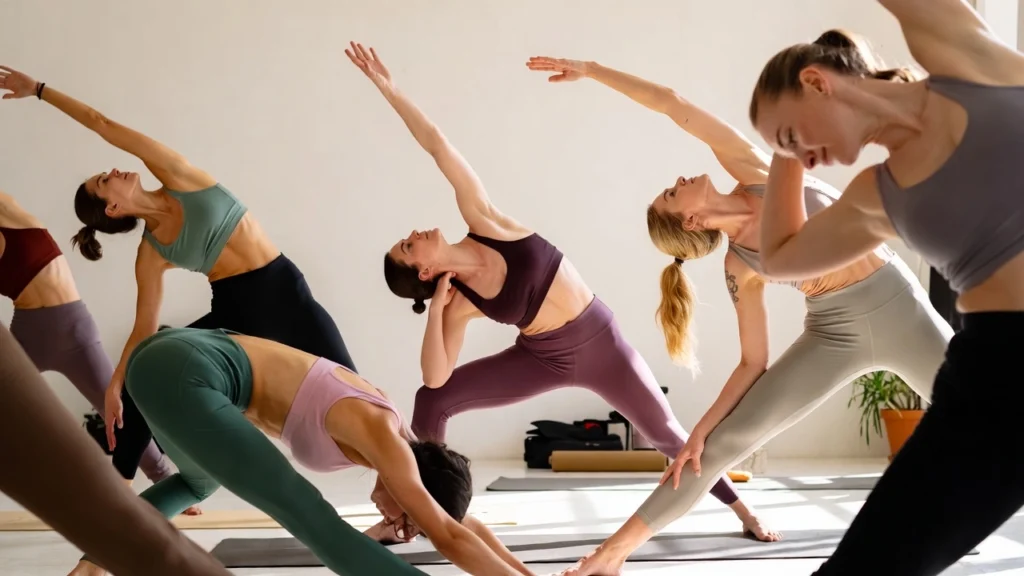
Yoga Poses for Dance
Introduction: Why Yoga Empowers Dancers
Storytellers with their motions, dancers convey their emotions, narratives, and power with each leap, pirouette, and gesture. It means that fluidity and precision necessitate the use of a body not just that is flexible, but also stable, responsive, and resilient. Yoga Poses For Dance offers a complete platform for developing all these attributes together.
In contrast to regular stretching exercises, yoga combines strengthening, flexibility, core stability, balance, and mindful awareness, which allows dancers to practice movements with more elegance, control,l and grace. Integrating yoga with a dance routine not only increases the physical performance of a given dance but also minimizes the risk of injury very minimally.
You will find the best yoga poses that cater to the needs of dancers in this complete guide, step-by-step instructions, variations, supporting sequences, weekly routines, injury prevention tips, and answers to the most asked questions on the synergy of yoga and dance.
What Is Yoga for Dance?
Dancer yoga refers to a form of yoga that emphasizes yoga postures and body motions that are used strategically with a view to enhancing mobility, strength, alignment, and the sense of body. As opposed to the common practice of stretching or other common practices of informal flexibility, yoga combines the physical, neurological, and psychological systems in order to create a harmonious body capable of moving gracefully and under control.
How Yoga Benefits Dancers
- Stretchs muscular tissue in order to facilitate the movement of fluid.
- Trains the balancing muscles, which are essential for balancing.
- Improves the space awareness (proprioception).
- Improves stamina and performance through breathing in.
- Maximizes the postures to limit strain and injury.
Yoga teaches dancers to relate mind and body, which helps them become focused, precise, and easy to move on, which directly effects to high stage performance.
The Scientific Basis of Yoga & Dance Performance
Yoga is not all stretching–it has a scientifically proven influence on flexibility, neuromuscular coordination, balance, and endurance. Studies have always indicated that the incorporation of yoga in the training of a dancer improves:
- ROM – increased higher leg lifting, more lunging, and extensions of fluids.
- Muscle coordination – enhancing controlled transition and complex choreography.
- Balance and proprioception – helps in maintaining balance during spins and arabesques.
- Breath endurance – helps to sustain long series without exhaustion.
The movements are safer, stronger, and more expressive when muscles are flexible and stable.
Scientific Insights:
- Greater Flexibility: Yoga dancers have been established to be more flexible in their hamstrings and hips.
- Neuromuscular Coordination: Yoga improves the connection that exists between the mind and the body, and this makes the dances more flowing and timely.
- Breath Control: The breathing practices of Yoga are used to enhance stamina andreduce anxiety over performance.
The application of yoga in dance training is a great method to enhance the artistry and biomechanics.
Why Dancers Should Perform a Yoga Warm-Up
Before one does any deep stretches or advanced poses, it is important to stretch the body. Warm-up enhances blood circulation, muscle contractions, and the joints to be in a position that will move, which minimizes the strains or injuries.
Simple 5-Step Warm-Up for Dancers
| Exercise | Duration | Purpose |
| Diaphragmatic Breathing | 1–2 minutes | Prepares lungs, focuses mind |
| Cat-Cow Flow | 30 seconds | Mobilizes spine, engages core |
| Arm Circles | 10 each direction | Opens shoulders, warms upper back |
| Hip Circles | 10 each direction | Increases hip mobility and turnout |
| Ankle Rolls | 10 per side | Prepares ankles for balance and jumps |
Pro Tip: Warming is a nice activity to do so the performing poses better and become more comfortable, and the strain in longer poses decreases.
Top Yoga Poses for Dance
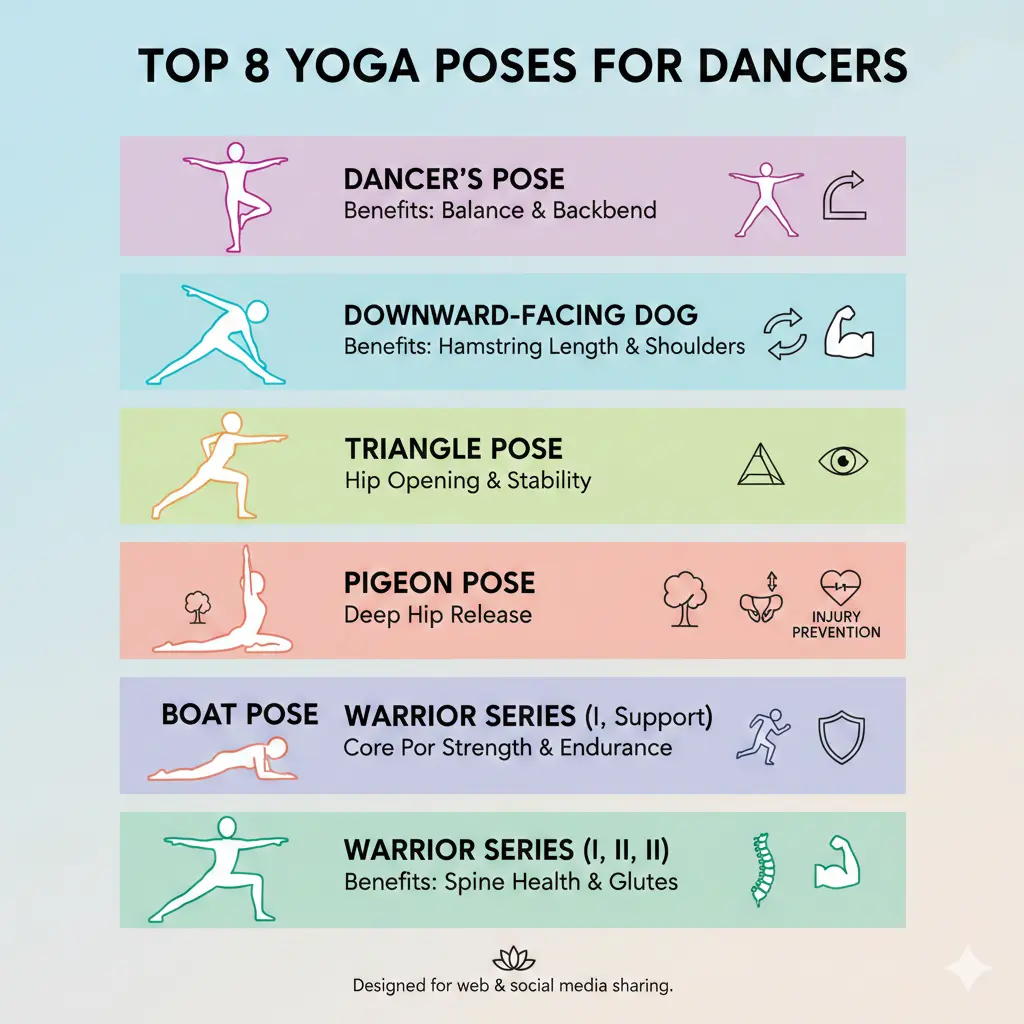
They are the most Appropriate yoga poses for a dancer with their benefits, directions, variations of a pose, common mistakes, and measures of precautions.
Dancer’s Pose
Benefits:
- Enhances balance and stability
- Opens hip flexors and quadriceps
- Strengthens legs and core
- Improves spinal extension
How to Perform:
- Stand upright, feet together.
- Move weight to the right foot.
- Hold the left foot inside and bend the left knee.
- One breath and left foot on the rise.
- Extend the right arm forward.
- Remember 30-45 seconds; repeat on the opposite side.
Variations:
- Tight hamstrings- put a yoga strap around the foot.
- Balance support Practice at a wall.
Common Mistakes:
Allowing the lifted hip to rotate outward
Collapsing the chest forward
Safety Notes: Avoid if you have knee or lower back injuries.
Downward-Facing Dog
Benefits:
- Full-body elongation
- Stretches hamstrings, calves, and shoulders
- Prepares for deeper poses
How to Perform:
- Begin on hands and knees.
- Spread fingers wide, press into palms.
- Lift your hips up and back.
- Straighten legs while keeping ears between arms.
- Hold 30–60 seconds.
Variations:
- Slightly bend knees to focus on spinal alignment
- Walk feet to release calves
Common Mistakes:
Rounding the spine
Collapsing shoulders
Safety Notes: Avoid locking elbows.
Triangle Pose
Benefits:
- Improves side flexibility and lateral extensions
- Opens hips and hamstrings
- Encourages alignment awareness
How to Perform:
- Step feet wide apart, turn the right foot outward.
- Extend arms parallel to the floor.
- Hinge at the right hip and reach forward.
- Lower hand to shin, block, or floor.
- Open chest, gaze upward.
Variations: Use a block if reaching the floor is difficult.
Common Mistakes: Twisting the torso forward rather than opening sideways.
Tree Pose
Benefits:
- Improves balance and proprioception
- Strengthens ankle stabilizers
- Enhances core engagement
How to Perform:
- Stand tall, feet together.
- Hold one leg (right foot) on the inside of the left thigh or calf.
- Bend the hands to the middle of the heart or above the head.
- Hold 30-60 seconds; switch sides.
Variations: Stand near a wall if balance is challenging.
Common Mistakes: Placing the foot directly on the knee.
Pigeon Pose
Benefits:
- Opens hips deeply
- Facilitates turnout
- Releases tight glutes
How to Perform:
- On hands and knees, come forward with the right knee to the mat.
- Instruct the straight back of one leg, which is the left one.
- Fold over the leg in front of the body.
Variations: Place a block under the hips for support.
Common Mistakes: Forcing the hips square or pushing too deep.
Safety Notes: Avoid if experiencing sharp hip pain.
Boat Pose
Benefits:
- Strengthens core and spine
- Supports balance and control for jumps and turns
- Engages hip flexors
How to Perform:
- Sit with knees bent, feet flat.
- Lift legs off the ground.
- Balance on sit bones.
- Extend arms forward; hold 30–60 seconds.
Variations: Bend knees slightly if needed.
Common Mistakes: Rounding the spine or collapsing chest.
Bridge Pose
Benefits:
- Strengthens glutes and back
- Opens hip flexors
- Prepares for deeper backbends
How to Perform:
- Lie on your back, feet hip-width apart.
- Lift hips toward the ceiling.
- Hold 30–60 seconds.
Variations: Place a block under the Sacrum For Support.
Supporting Yoga Poses for Dance
In addition to the main poses, these supportive postures enhance stability, flexibility, and strength:
- Plank Pose: Core engagement
- Side Plank: Oblique strength
- Forward Fold: Hamstring release
- Reclined Hip Openers: External rotation
How to Build a Weekly Yoga Regimen for Dancers
Beginner (3 Days/Week)
| Day | Focus |
| Day 1 | Balance + Core |
| Day 2 | Hip Openers + Spine Length |
| Day 3 | Strength + Full Sequence |
Intermediate (4–5 Days/Week)
- Add dynamic flows and longer holds
- Incorporate breathwork
Advanced (Daily Practice)
- Add inversions, personalized sequences
- Long-duration holds
Injury Prevention & Yoga Safety
Yoga prevents injuries only if practiced mindfully.
Safety Guidelines:
- Warm up before deep stretches
- Use props (blocks, straps)
- Move slowly and mindfully
- Stop if experiencing sharp pain
Avoid Yoga:
Recent injuries without doctor approval
Sharp joint pain
Dizziness or imbalance
FAQs
Is yoga good for ballet dancers?
Yes, yoga enhances turnout, flexibility, and balance essential for ballet.
How long should I hold each pose?
30–60 seconds or 3–5 breaths; longer holds improve flexibility.
Can yoga replace dance warm-ups?
Yoga is excellent for warming up, but dynamic movements should also be included.
Conclusion
Yoga and dance are two things that cannot be separated. This is done through the use of Yoga Poses in dancing to teach people how to become flexible, balanced, strong, and aware. Whether you are a beginner or a master, this mentor will provide you with all you require to be a smarter, more graceful, and confident performer in your training.
