
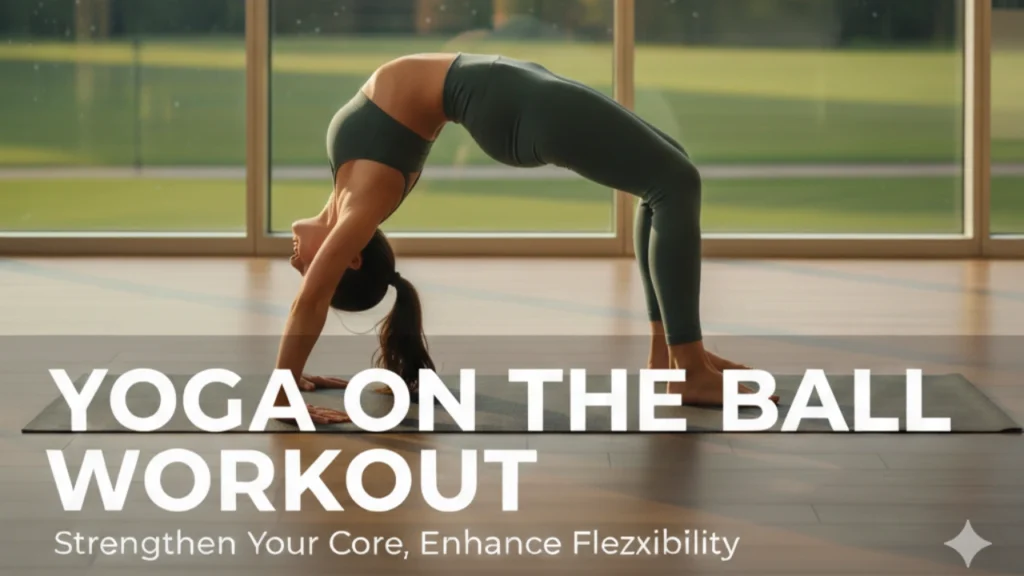
Yoga on the Ball Workout
Stability Ball Yoga, commonly also known as yoga on the ball, Swiss ball yoga, or yoga and an exercise ball, yoga on the ball workout is a new form of traditional yoga practice. It wisely incorporates classical yogic movements with modern functional training principles of using a stability ball as a central prop. primary prop.
This practice is a mixture of mindfulness, awareness of breath, and focus on alignment of the yoga with the neuromuscular activity, balance requirement, and engagement of the core offered by an unstable surface. The consequence is an exercise that is composed yet difficult, smooth yet very successful.
In contrast to the traditional mat-based yoga, a ball workout in yoga presents a controlled instability. The body must adjust micro-adjustments on a regular basis due to such instability and this necessitates that the muscles, joints and the nervous system be alert, coordinated and responsive. All the poses are a half-body experience rather than a separate stretch.
Due to the increasing sedentary nature of modern lifestyles there is an increasing number of problems facing people in Europe and around the world and they include:
- Poor posture from prolonged sitting
- Chronic lower back discomfort
- Weak deep core muscles
- Reduced balance and coordination
- Joint stiffness and limited mobility
The yoga on the ball is a science based, low impact intervention, which is joint friendly and accessible to beginners and office workers, those who are elderly, rehabilitation patients (with their permission) and those who are advanced yoga practitioners.
What Is Yoga on the Ball?
Yoga on the ball is the mindfulness movement activity, during which the yoga poses are combined with the use of the stability ball to enhance the feeling of balance, coordination, awareness of the posture, and involvement with deep core.
Instead of rolling on a permanent and solid yoga mat, the meditator would roll on a large, inflated exercise ball. Poses may be performed while:
- Sitting on the ball
- Lying across the curved surface
- Placing hands, feet, knees, or shins on the ball
- Using the ball as a dynamic or static support
This mere alteration of the surface has a dramatic effect on the reaction of the body. The muscles that are usually inactive during mat yoga, especially deep stabilizers,s need to be activated at all times to achieve equilibrium.
From an NLP and movement-science perspective, yoga on the ball enhances:
- Sensorimotor coordination
- Postural reflexes
- Proprioceptive feedback loops
- Mind–body connection
It is not a replacement for classical yoga; rather, it is an extension and enhancement of it.
How Yoga on the Ball Works
Intentional instability is the characteristic of a yoga on the ball workout.
A stability ball flattens, moves and rolls under your body in a subtle manner. With this motion, your neuromuscular system is forced to change in the real time. As a result, your body must:
- Activate the deep stabilizing muscle
- Improve proprioception (body awareness in space)
- Maintain joint alignment under dynamic conditions
- Coordinate movement with breath
- Sustain mental focus and presence
Unlike traditional gym-based ball workouts that emphasize speed or repetition, yoga on the ball remains grounded in yogic principles. Movements are:
- Slow and deliberate
- Breath-synchronized
- Alignment-focused
- Controlled rather than forceful
This ensures that the practice remains safe, mindful, and therapeutic rather than aggressive or destabilizing.
Yoga on the Ball vs Regular Yoga
| Feature | Regular Yoga | Yoga on the Ball |
| Practice surface | Stable yoga mat | Unstable stability ball |
| Core engagement | Moderate | High and continuous |
| Balance requirement | Pose-dependent | Constant |
| Joint stress | Low | Very low |
| Mind–body awareness | High | Extremely high |
| Postural training | Moderate | Excellent |
The yoga on the ball exercising is not a substitute of the Traditional Yoga. Rather, it enhances muscular awareness and introduces a functional aspect of training which is highly valued by the modern bodies.
Evidence-Backed Benefits of Yoga on the Ball
Deep Core Strength & Stability
Among the greatest benefits of yoga on the ball, there is greater activation of the deep core musculature. These are the muscles that are vital to the health of the spine and posture, but they are not frequently utilized in the normal workout.
Key muscles activated include:
- Transverse abdominis
- Multifidus
- Pelvic floor muscles
- Deep internal and external obliques
Repeated scientific studies in the rehabilitation field and sports science have demonstrated that unstable surface training enhances the deep core activity as compared to that of training on firm surfaces.
This makes yoga on the ball particularly effective for:
- Preventing lower back pain
- Improving spinal stability
- Enhancing postural endurance
- Supporting functional movement patterns
Improved Balance & Proprioception
Balance is not a physical ability, it is a neurological process.
During practice on the ball, the brain is constantly being fed with sensory input of the muscles, joints and connective tissues. This feedback improves:
- Static and dynamic balance
- Coordination and motor control
- Reaction time
- Fall prevention ability
This benefit is especially valuable for:
- Older adults
- Beginners developing body awareness
- Individuals returning to movement after injury (with guidance)
Enhanced Flexibility with Safer Range of Motion
The curved surface of a stability ball provides support and adaptability that flat surfaces cannot.
This allows for:
- Gentler spinal extension and flexion
- Supported backbends
- Controlled hip opening
- Reduced joint compression
As a result, flexibility improves without forcing end ranges of motion. This significantly lowers the risk of overstretching or strain.
Better Posture & Spinal Alignment
Sitting and moving on a ball naturally encourages:
- Neutral spine positioning
- Engagement of postural muscles
- Awareness of habitual slouching
This makes the yoga on the ball workout particularly beneficial for:
- Desk workers
- Students
- People with rounded shoulders or forward head posture
Over time, posture improves not just during practice, but in daily life as well.
Low-Impact & Joint-Friendly Exercise
Yoga on the ball places minimal stress on major joints such as:
- Knees
- Hips
- Ankles
Because movements are controlled and supported, this practice is suitable for:
- Beginners
- Seniors
- People easing back into movement after injury (with approval)
General Rules Before You Start
Before beginning any yoga on the ball workout, follow these foundational guidelines:
- Choose the correct ball size
- Use a non-slip yoga mat
- Practice barefoot or wear grip socks
- Move slowly and consciously
- Prioritize control over depth
- Maintain smooth, relaxed breathing
Safety Tips & Precautions
Who Should Be Extra Careful
- Individuals with acute back or neck injuries
- People with severe balance disorders
- Post-surgery patients
- Anyone experiencing dizziness, sharp pain, or numbness
Always consult a healthcare professional if uncertain.
Common Mistakes to Avoid
- Holding the breath
- Rushing between poses
- Using an overinflated or undersized ball
- Ignoring core engagement
- Locking joints
Yoga on the Ball Workout
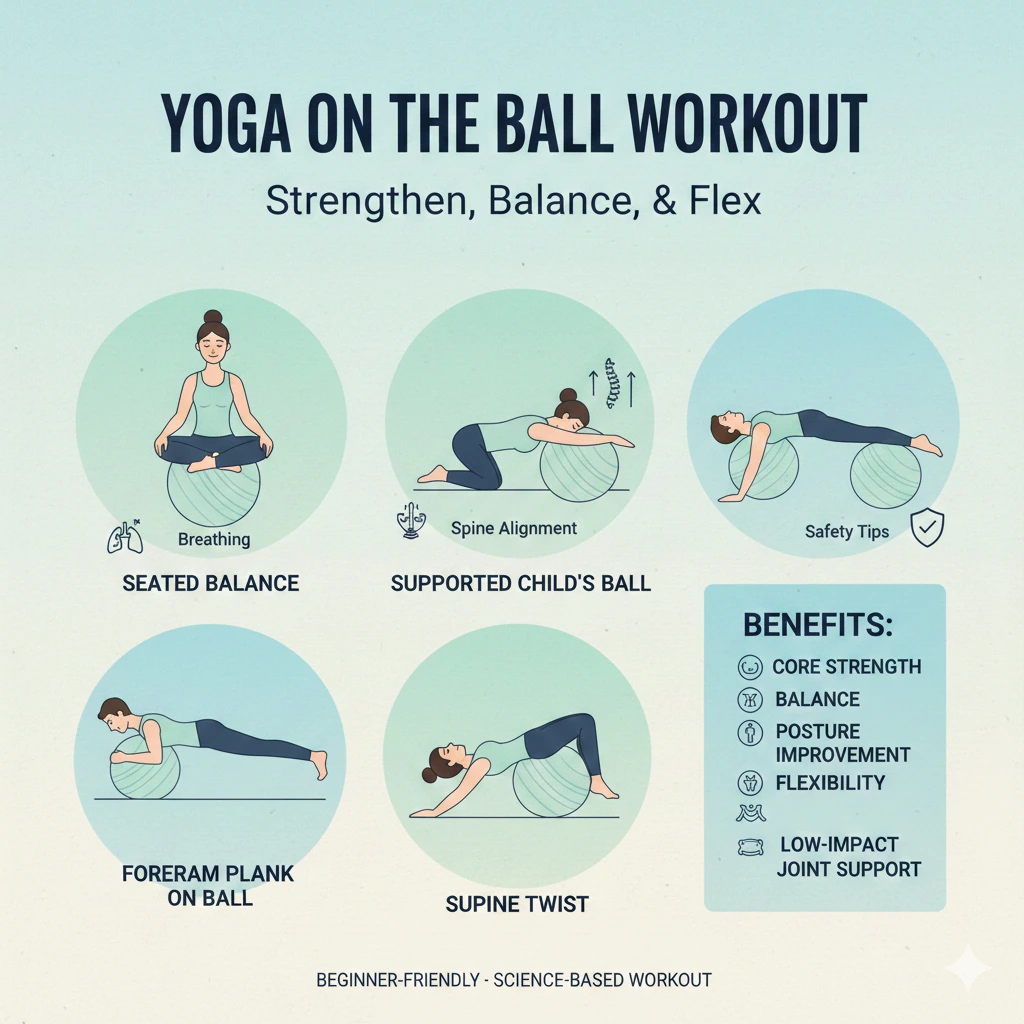
Seated Breath Awareness
How to do it:
- Sit upright on the ball
- Feet hip-width apart
- Inhale deeply through the nose
- Gently activate your core muscles
Benefits:
Postural awareness, breathing control, balance
Duration:
1–2 minutes
Seated Single-Leg Balance
- Lift one foot slightly off the floor
- Maintain a tall posture
- Switch sides
Muscles targeted:
Deep core stabilizers, hip flexors
Tip:
Fix your gaze on a steady point
Supported Child’s Pose
- Kneel with forearms resting on the ball
- Slowly roll the ball forward
- Relax the spine and shoulders
Benefits:
Spinal decompression, nervous system calming
Breathing:
Slow nasal breathing
Bridge Pose with Ball
- Lie on your back
- Place heels on the ball
- Lift hips slowly while engaging glutes
Muscles:
Glutes, hamstrings, spinal extensors
Reps:
10–12
Supine Twist with Ball
- Place the ball under the shins
- Drop knees gently side to side
Benefits:
Lower back relief
Duration:
30–60 seconds
Intermediate Yoga on the Ball Flow (20–25 Minutes)
Key Poses
- Forearm Plank on Ball
- Bridge Marches
- Wall-Supported Ball Squats with Twist
Focus Areas
- Dynamic balance
- Core endurance
- Fluid transitions
- Breath coordination
Advanced Yoga Ball Exercises
| Pose | Difficulty | Key Benefit |
| Ball Pike to Plank | Advanced | Core power |
| Warrior III on Ball | Advanced | Balance & focus |
| Side Plank Leg Lift | Advanced | Oblique strength |
Advanced movements should only be practiced after mastering foundational skills.
Step-by-Step Progression Strategy
To progress safely and effectively:
- Increase hold durations
- Add slow, controlled transitions
- Reduce the all or hand support
- Introduce asymmetrical poses
- Track balance consistency and breath control
Proper Form & Alignment Guidelines
- Maintain a neutral spine
- Gently engage the core (avoid bracing)
- Keep shoulders relaxed
- Align joints carefully
- Move with intention and control
Breathing Technique
Use Diaphragmatic nasal breathing:
- Inhale to prepare
- Exhale during balance challenges
- Never hold your breath
Muscles Targeted
- Deep core stabilizers
- Gluteal muscles and hip stabilizers
- Spinal extensors
- Postural support muscles
Variations by Level
Beginner
- Wall-supported balances
- Seated stability poses
Intermediate
- Partial planks
- Dynamic transitions
Advanced
- Single-limb balances
- Integrated flow sequences
Contraindications: Who Should Avoid It
- Acute disc herniation
- Severe vertigo
- Recent spinal surgery
Safety must always take priority.
Duration & Frequency
| Level | Time | Frequency |
| Beginner | 10–15 min | 3× / week |
| Intermediate | 20–30 min | 4× / week |
| Advanced | 30–40 min | 4–5× / week |
Yoga Philosophy & Science Behind It
Yoga on the ball embodies the yogic principles of:
- Sthira (steadiness)
- Sukha (ease)
The unstable surface teaches calmness under challenge — physically, mentally, and neurologically.
From a neuroscience perspective, it enhances sensorimotor integration, strengthening the connection between intention, movement, and awareness.
Home Workout Setup Tips
- Use a high-quality anti-burst stability ball
- Practice near a wall for safety
- Keep the area clutter-free
- Use mirrors for alignment feedback
Pros & Cons of Yoga on the Ball
Pros
- Improves balance and posture
- Joint-friendly and low-impact
- Engaging and enjoyable
- Ideal for home practice
Cons
- Not suitable for acute injuries
- Requires learning and adaptation
- Ball size must be correct
FAQs
Yes. It strengthens stabilizing muscles and supports spinal alignment when practiced correctly.
Yes, with proper modifications and external support.
3–5 sessions per week is optimal.
Absolutely. Start with seated and supported movements.
Conclusion
The Yoga On The Ball exercise is not just a body shaping craze. It is a breathing conscious development of yoga and a combination of the old science with the new movement science. Safely and regularly, it provides power, equilibrium, consciousness, and stability both on and off the mat.
