
Introduction
Yoga words is much more than doing stretches on the mat or flexing over for pictures. It is a total, whole-person development system that started a millennium ago in ancient India. These days, yoga classes are being taken in London, Berlin, Madrid, Milan, New York, Toronto, and everywhere in the world. Malicious lights are installed in the studios, microphones are used by instructors, and even classes can be broadcast via the Internet.
However, no matter how popular it is all over the globe, there is still something that puzzles many novices and even those who have arrived at the intermediate stage:
The language of yoga.
During a session, you hear such strange words as Asana, Pranayama, or Dhyana, and you can question silently:
What is the meaning of these yoga words?
Why are they in Sanskrit?
Do I need to memorize them?
Are they spiritual or religious?
This is a full 2026 guide pillar to yoga words that can be understood by everyone, in a language that is easy and easily accessible, and structured in an optimized, NLP-based terminology by modern learners.
What Are Yoga Words?
Yoga terms refer to the Sanskrit and English terms that are employed during yoga practice, yoga philosophy, yoga meditation, yoga anatomy, Yoga Breathwork, yoga mindfulness, yoga sequencing, yoga teaching, and yoga spiritual exploration.
They include:
- Name the poses (Tadasana, Vrikshasana)
- Breathing (Pranayama, Ujjayi).
- Religious values (Dharma, Karma).
- Vital notions (Chakra, Nadi).
- Instructional cues (engage, ground, stabilize, align)
Learning yoga words helps you:
- Feel confident in class
- Comprehend deeper meaning
- Refine alignment
- Connect with authentic tradition
- Enhance awareness and embodiment
Why Are So Many Yoga Words in Sanskrit?
Yoga began in ancient India over 5000 years ago. Sanskrit was the classical spiritual, scholarly and liturgical language in those days.
Numerous teachings form the foundation of texts like:
- Yoga Sutras of Patanjali
- Bhagavad Gita
- Hatha Yoga Pradipika
Just like the fact that Latin still exists in the medical world, Sanskrit still has the original spirit and contextual richness of yogic concepts.
For example:
- Asana does not merely mean “pose.” It signifies a stable, comfortable seat.
- Prana does not simply refer to oxygen release.
- The word Dhyana does not mean relaxation, but long-term meditation.
Knowing original yoga words helps to avoid superficiality but promotes embodied consciousness.
The Root Meaning of Yoga
The word “Yoga” derives from the Sanskrit root Yuj, meaning:
- To unite
- To yoke
- To integrate
Yoga represents union between:
- Body
- Breath
- Mind
- Awareness
- Individual consciousness and universal consciousness
In many Western contexts, yoga emphasizes physical fitness. Conventionally, however, yoga is a disciplined methodology of inner harmony, clarity, liberation, and self-realization.
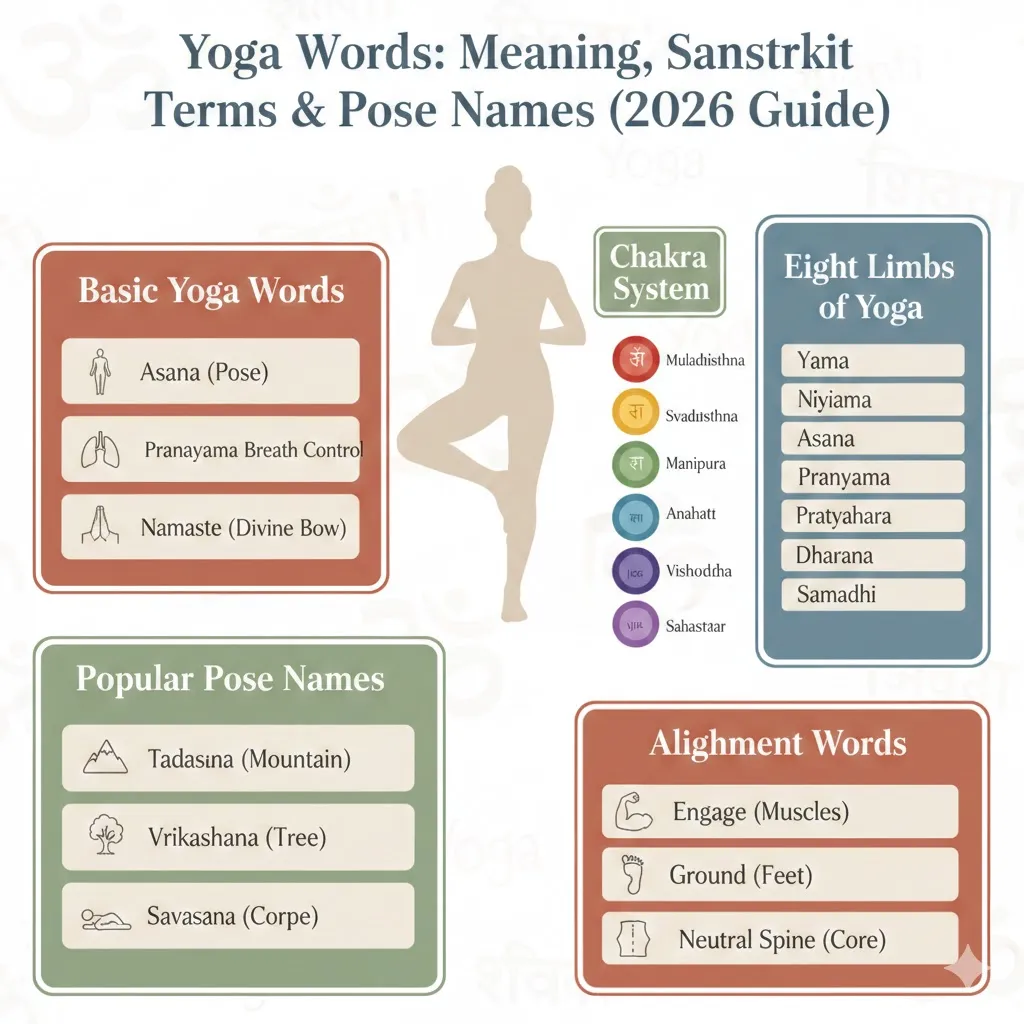
Basic Yoga Words Every Beginner Should Know
Below are foundational yoga words used internationally.
| Sanskrit Word | Meaning | Practical Application |
| Yoga | Union | Complete system |
| Asana | Posture | Tree Pose |
| Pranayama | Breath regulation | Ujjayi breathing |
| Mantra | Sacred sound | “Om” |
| Mudra | Hand gesture | Gyan Mudra |
| Chakra | Energy center | Heart chakra |
| Guru | Teacher or guide | Yoga instructor |
| Namaste | I bow to you | Closing greeting |
Conventionally, however, yoga is a disciplined methodology of inner harmony, clarity, liberation and self-realization.
Essential Yoga Pose Words
Most yoga pose names describe:
- The shape of the body
- Animals
- Nature elements
- Mythological figures
- Philosophical symbols
Understanding pose-based yoga words improves cognitive retention and physical precision.
Tadasana
Meaning: Mountain posture
Symbolism: Stability, grounding, dignity
Benefits:
- Improves posture alignment
- Strengthens quadriceps
- Engages core stabilizers
- Activates foot arches
Breathing: The breath in is constant and steady, and exhaled steadily.
It may seem easy, but Tadasana provides neuromuscular awareness and basic stability.
Adho Mukha Svanasana
Meaning: Downward-facing dog
Benefits:
- Stretches hamstrings and calves
- Strengthens shoulders and arms
- Enhances circulation
- Elongates spine
Common mistake: Rounding the thoracic spine instead of lengthening it.
Virabhadrasana I
Named after a warrior associated with Lord Shiva in Hindu mythology.
Benefits:
- Strengthens legs
- Improves balance
- Expands chest
- Builds resilience and determination
This pose symbolizes courage and grounded strength.
Vrikshasana
Meaning: Tree posture
Benefits:
- Improves equilibrium
- Enhances focus
- Strengthens ankles
- Develops mental steadiness
Tree Pose trains proprioception and cognitive concentration.
Savasana
Often misunderstood as “just lying down.”
True purpose:
- Calms the nervous system
- Integrates neuromuscular patterns
- Supports meditation
- Reduces cortisol levels
Savasana promotes parasympathetic activation and psychological assimilation.
Spiritual & Philosophical Yoga Words
Yoga is not limited to physical postures. It entails morality and intellectual polish.
The Yoga Sutras of Patanjali describe these teachings.
The Eight Limbs of Yoga
| Limb | Meaning |
| Yama | Moral discipline |
| Niyama | Personal observances |
| Asana | Posture |
| Pranayama | Breath expansion |
| Pratyahara | Sensory withdrawal |
| Dharana | Concentration |
| Dhyana | Meditation |
| Samadhi | Enlightenment |
When you understand these yoga words, yoga evolves into a lifestyle—not merely exercise.
Chakra-Related Yoga Words
Chakras are subtle energetic centers within the body.
| Chakra | Location | Theme |
| Muladhara | Base of spine | Security |
| Svadhisthana | Lower abdomen | Creativity |
| Manipura | Solar plexus | Power |
| Anahata | Heart | Love |
| Vishuddha | Throat | Communication |
| Ajna | Between eyebrows | Intuition |
| Sahasrara | Crown | Spiritual awareness |
Chakra vocabulary is common in meditation and Kundalini traditions.
Meditation & Breath Vocabulary
Pranayama
Breath expansion and energetic regulation.
Popular types include:
- Ujjayi
- Kapalbhati
- Nadi Shodhana
Om (Aum)
Yoga is not limited to physical postures. It entails morality and intellectual polish.
The Yoga Sutras of Patanjali describe these teachings.
Modern Yoga Style Words
Over centuries, yoga diversified into distinct methodologies:
- Hatha Yoga
- Vinyasa Yoga
- Ashtanga Yoga
- Bikram Yoga
- Kundalini Yoga
Each style emphasizes different sequencing, terminology, breath patterns, and energetic focus.
Understanding “Sexiest Yoga Poses” – A Healthy Perspective
The phrase “sexiest yoga poses” frequently appears in search engines.
However, yoga was never designed for aesthetic display.
Typically, this phrase refers to poses that:
- Enhance body confidence
- Strengthen glutes and core
- Improve posture
- Create graceful alignment
Examples often associated with this query:
- Camel Pose
- Wheel Pose
- Dancer Pose
- Warrior III
Important reminder:
Yoga is not a matter of objectification but of empowerment, presence and embodiment.
True beauty is achieved through perception and self-confidence.
Alignment & Safety Yoga Words
Instructors use many technical yoga words during sessions.
Common cues include:
- Engage
- Activate
- Lengthen
- Ground
- Stack joints
- Neutral spine
- Micro-bend
- Root down
- Lift through the crown
Understanding these terms reduces injury risk and enhances biomechanical precision.
Additional Essential Yoga Words List
Physical Practice Terms
- Drishti – Focus point
- Bandha – Energy lock
- Vinyasa – Flow sequence
- Surya Namaskar -adoration of the Sun.
- Chaturanga -Four-limb staff pose.
- Utkatasana – Chair Pose
- Bhujangasana – Cobra Pose
- Balasana – Child’s Pose
- Setu Bandha – Bridge Pose
- Ardha – Half
Philosophical Terms
- Dharma – Life purpose
- Karma – Action and consequence
- Ahimsa – Non-violence
- Satya – Truthfulness
- Aparigraha – Non-possessiveness
- Santosha – Contentment
- Tapas – Discipline
- Svadhyaya – Self-inquiry
- Ishvara – Higher awareness
Energy & Subtle Body Words
- Nadi – Energy channel
- Ida – Left channel
- Pingala – Right channel
- Kundalini – Coiled energy
- Prana – Vital force
- Shakti – Divine feminine energy
Step-by-Step: How to Learn Yoga Words Effectively
Learning Yoga Vocabulary can feel overwhelming. Follow this structured system:
Start Small
Memorize 10 common Sanskrit terms first.
Practice Pronunciation
Example:
Tadasana (Tah-DAH-sah-nah)
Use Flashcards
Digital or paper-based repetition strengthens retention.
Learn by Category
Group by pose names, breathing terms, philosophy, and alignment cues.
Apply in Class
Alternate between English and Sanskrit usage.
Study One Limb Weekly
Deep-dive into one of the Eight Limbs per week.
Common Mistakes When Learning Yoga Vocabulary
- Trying to memorize everything simultaneously
- Ignoring phonetic pronunciation
- Focusing solely on pose terminology
- Misinterpreting spiritual words
- Using sacred terms casually
Pros & Cons of Learning Yoga Words
Pros
- Builds confidence
- Deepens spiritual comprehension
- Enhances alignment awareness
- Connects to authentic lineage
- Simplifies international class participation
Cons
- Initially challenging
- Sanskrit pronunciation may feel complex
- Excess theory without embodiment can confuse beginners
Cultural Respect & Awareness
Yoga originates from the Indian tradition. It is important to:
- Respect its heritage
- Avoid mocking pronunciation
- Avoid commercializing sacred language
- Learn with humility
Yoga is spiritual but not confined to a single religion.
FAQs About Yoga Words
Why are yoga words important?
They preserve original meaning and deepen understanding beyond physical exercise.
Do I need Sanskrit to practice yoga?
No. But learning basic yoga words improves confidence.
Are yoga words religious?
Yoga is spiritual but not limited to one religion.
What are the most important yoga words?
Yoga, Asana, Pranayama, Dhyana, Chakra, Savasana.
Why do instructors say “Namaste”?
It expresses respect and gratitude.
Conclusion
Understanding yoga words transforms everything.
Practicing with awareness
Simple exercise
Conscious self-development
Whether you practice in Berlin, Barcelona, Birmingham, Boston, or beyond, mastering yoga vocabulary provides:
- Stronger alignment
- Sharper concentration
- Spiritual clarity
- Global confidence
The more deeply you understand the language of yoga, the more authentic, integrated, and empowered your journey becomes
