

A Yoga Instructor Wants to Arrange Students
Introduction
Many mathematical scenarios in school, competitive exams, and reasoning assessments start with relatable real-world situations. An example is: “A Yoga Teacher desires to organize the students into neat rows and columns. These issues do not seem too complex, however, yoga instructor at their core, they contain some important notions like perfect squares, square roots, the least common multiple (LCM) and strategies of logical arrangement.
Through practicing the problems, the learners improve their rates of problem solving, accuracy and logical thinking. An example of the use of yoga classes, classroom arrangements, or workshops by the teachers is to make abstract mathematical ideas more concrete.
In a real-world perspective, yoga teachers should also have properly arranged students. In big retreats in Europe, in workshops in Italy or urban yoga studios in the USA, it is important to organize the students in a row, in a circle, and in partner-based structures. Even some classes combine duo yoga poses, which need to be highly coordinated, and space-planned..
Understanding the Core Concept
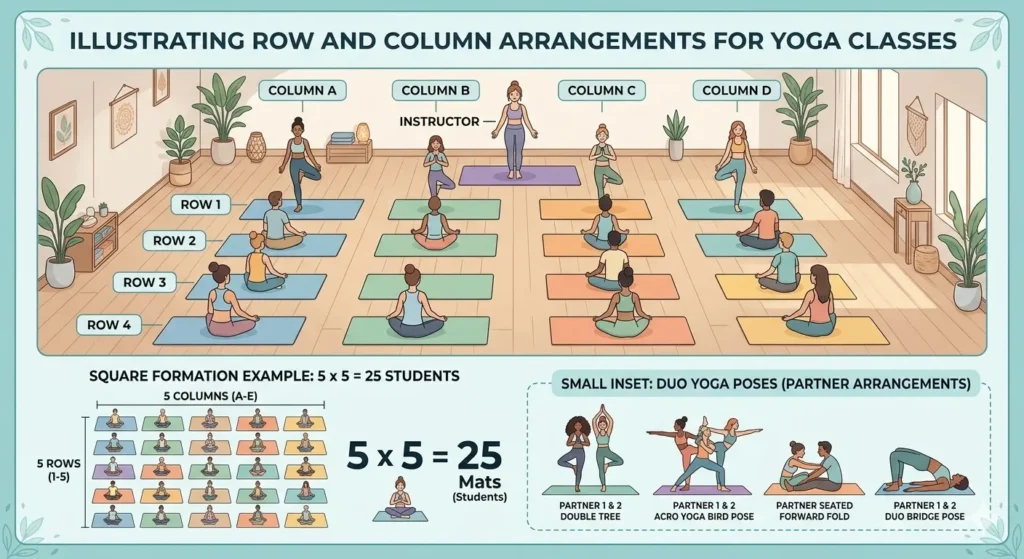
A question that starts with a yoga instructor wants to arrange students generally means to methodically arrange students in grid like fashion. In mathematics this translates to providing the students in lines and columns with rectangular or square structures.
Basic Mathematical Principle
The total number of students can be expressed as:
Total Students=Rows×Columns\text{Total Students} = \text{Rows} \times \text{Columns}Total Students=Rows×Columns
| Rows | Columns | Total Students |
| 4 | 5 | 20 |
| 6 | 6 | 36 |
| 10 | 8 | 80 |
When the rows are equal to the columns, then the resulting arrangement creates a perfect square formation, which is often exercised in mathematics tests.
e.g. 5 rows x 5 columns = 25 students.
The arrangement of students is based on this basic principle which forms the core of most of the issues surrounding yoga instructors.
Visualizing Rows and Columns
To better comprehend the problem, imagine a Yoga studio where students occupy mats:
- Rows: Horizontal lines of mats
- Columns: Vertical lines of mats
For example:
- Rows = 4
- Columns = 4
- Total Students = 16
This is a perfect square arrangement, which is common in:
- Math exercises
- Classroom or workshop organization
- Yoga retreats and group sessions
Square Formation in Mathematics
When the number of rows is equal to the number of columns, a square formation is formed. This pattern results in a square number of students, which is a fundamental concept of math problems of an arrangement type.
Examples of Perfect Squares
| Rows | Columns | Students |
| 2 | 2 | 4 |
| 3 | 3 | 9 |
| 4 | 4 | 16 |
| 5 | 5 | 25 |
| 10 | 10 | 100 |
Common Perfect Squares: 1, 4, 9, 16, 25, 36, 49, 64, 81, 100
These numbers are significant in solving problems promptly when a yoga instructor desires to have students organized in a square.
Real-Life Example: Yoga Class Organization
In other countries such as Spain, Italy, and Greece, the instructors coordinate the students in formations. This guarantees the balanced practice experience, the maximum of visibility, spatial awareness and energy alignment.
Common Arrangement Styles
- Row Layout:
- Ideal for large studios, breathwork, and meditation classes
- Ensures all students are visible to the instructor
- Circle Layout:
- Perfect for community sessions, group discussions, and energy-sharing exercises
- Encourages inclusivity and engagement
- Partner Layout:
- Used as a duo yoga pose, assisted stretches and balance poses.
- Enhances trust, cooperation and coordination.
These practical structures find duplication in mathematical arrangements which reveal the interrelationship between logic and practical yoga.
Step-by-Step Method to Solve Arrangement Problems
When tackling “a yoga instructor wants to arrange students” problems, follow these steps:
Step 1 – Identify the Total Number of Students
Typical examples include: 200, 500, 1000, or 2000 students.
Step 2 – Determine Arrangement Type
- Square arrangement (rows = columns)
- Specific number of students per row
- Divisible patterns or remainder-based arrangements
Step 3 – Find the Nearest Perfect Square
If square formation is required, identify the largest perfect square smaller than the total number of students.
Step 4 – Calculate the Square Root
The square root gives the number of rows and columns.
Example:
144=12 ⟹ Rows = 12, Columns = 12\sqrt{144} = 12 \implies \text{Rows = 12, Columns = 12}144=12⟹Rows = 12, Columns = 12
Example Problems
Example 1: Arrange 2000 Students
- Nearest perfect square: 2000≈44\sqrt{2000} \approx 442000≈44
- Square arrangement: 44 × 44 = 1936
- Remaining students: 2000 − 1936 = 64
Answer: Rows = 44, Columns = 44, Remaining Students = 64
Example 2: Arrange 600 Students
- Nearest perfect square: 600≈24\sqrt{600} \approx 24600≈24
- Square arrangement: 24 × 24 = 576
- Remaining students: 600 − 576 = 24
Answer: Rows = 24, Columns = 24, Remaining Students = 24
Example 3: LCM-Based Arrangement
- Students arranged in rows of 8, 10, 14, 16 leaving 4 each time
- Find LCM: LCM(8,10,14,16) = 560
- Add remainder: 560 + 4 = 564
Answer: Total Students = 564
Application of Arrangement Logic in Yoga Classes
Mathematical arrangements are not only academic—they are practically applied in Yoga Classes:
- Visibility: Instructor monitors all students easily
- Alignment correction: Ensures proper form and posture
- Energy flow: Balanced spacing enhances group energy
- Synchronization: Students coordinate movements and breathing
Grid-like arrangements are especially useful for large workshops, resembling row-column systems in classrooms.
Duo Yoga Poses and Partner Arrangements
In partner yoga, teachers apply duo poses whereby two students are required to work together. Such structures focus on coordination, balance and trust.
Popular Duo Yoga Poses
- Partner Tree Pose
- Double Downward Dog
- Back-to-Back Seated Twist
- Partner Boat Pose
Benefits
- Improves balance and stability
- Builds mutual trust
- Enhances coordination
- Supports flexibility
Partner Tree Pose – Step by Step
- Stand side by side
- Place inner arms around each other
- Lift outer foot to inner thigh
- Maintain balance together
Key Advantage: Strengthens legs and builds confidence while promoting collaboration.
Comparison Table: Solo vs Duo Yoga Practice
| Feature | Solo Yoga | Duo Yoga Poses |
| Practice style | Individual | Partner-based |
| Difficulty | Beginner | Moderate |
| Balance training | Limited | Enhanced |
| Flexibility support | Self-guided | Assisted |
| Social interaction | Low | High |
Both solo and duo practices have value depending on class type, goals, and student experience.
Pros and Cons of Group Yoga Arrangements
Pros:
- Instructor can monitor all students
- Maintains order in large sessions
- Improves synchronization
- Ensures safe spacing
Cons:
- Less flexible in tight spaces
- Requires careful planning
- Some students prefer private space
Common Mistakes Students Make
- Ignoring perfect squares
- Incorrect square root calculations
- Forgetting to account for remaining students after square formation
Tips for Solving Problems Quickly
- Memorize perfect squares up to 50 (e.g., 25² = 625)
- Practice estimating square roots
- Identify the pattern (square, LCM, divisible) immediately
Practice Questions
- Arrange 1000 students in square formation. How many rows?
- Arrange 500 students where rows = columns. How many remain?
- Students arranged in rows of 6, 8, 10 leaving 2 each. Find smallest number of students.
Yoga Philosophy Behind Structured Practice
Structured arrangements in yoga reflect discipline, focus, and harmony. European yoga teachers emphasize alignment and order, mirroring mathematical structures. Organized formations help:
- Maintain energy balance
- Promote group focus
- Encourage cooperative practice
Tips for Beginners in Yoga Classes
- Arrive early to select a suitable mat spot
- Maintain appropriate spacing
- Follow instructor alignment cues
- Respect boundaries in duo poses
Recommended Practice Duration
| Level | Duration |
| Beginner | 20–30 min per session |
| Intermediate | 45–60 min |
| Advanced | 60–90 min incl. meditation & breathing |
Safety Tips
- Warm up before practice
- Avoid forcing flexibility
- Communicate during duo exercises
- Consult a physician if injured
Contraindications
Avoid intense yoga if you have:
- Severe joint injuries
- Spinal problems
- Uncontrolled blood pressure
Always follow the guidance of a certified instructor.
FAQs
A: Organizing students in rows and columns to form squares or rectangles.
A: Rows = Columns → total students = perfect square.
A: Relatable scenarios help students visualize arrangement problems.
A: Partner exercises that improve balance, flexibility, and coordination.
A: Yes, common in school, reasoning, and competitive tests.
Conclusion
Problems starting with “A Yoga Instructor wants to arrange students” may appear simple, but they teach:
- Multiplication patterns
- Perfect square concepts
- Logical arrangement strategies
The knowledge of rows, columns, and square formations gives faster and more accurate solutions. These arrangements are reflected in real-life yoga classes, increasing the visibility, balance, and energy flow.
Through practice, these issues can be conquered, which will enhance mathematical reasoning, logical thinking, and practical classroom/yoga management techniques. These situations are made friendly and even fun, whether it is in the case of competitive tests or in the daily problem-solving challenges.
